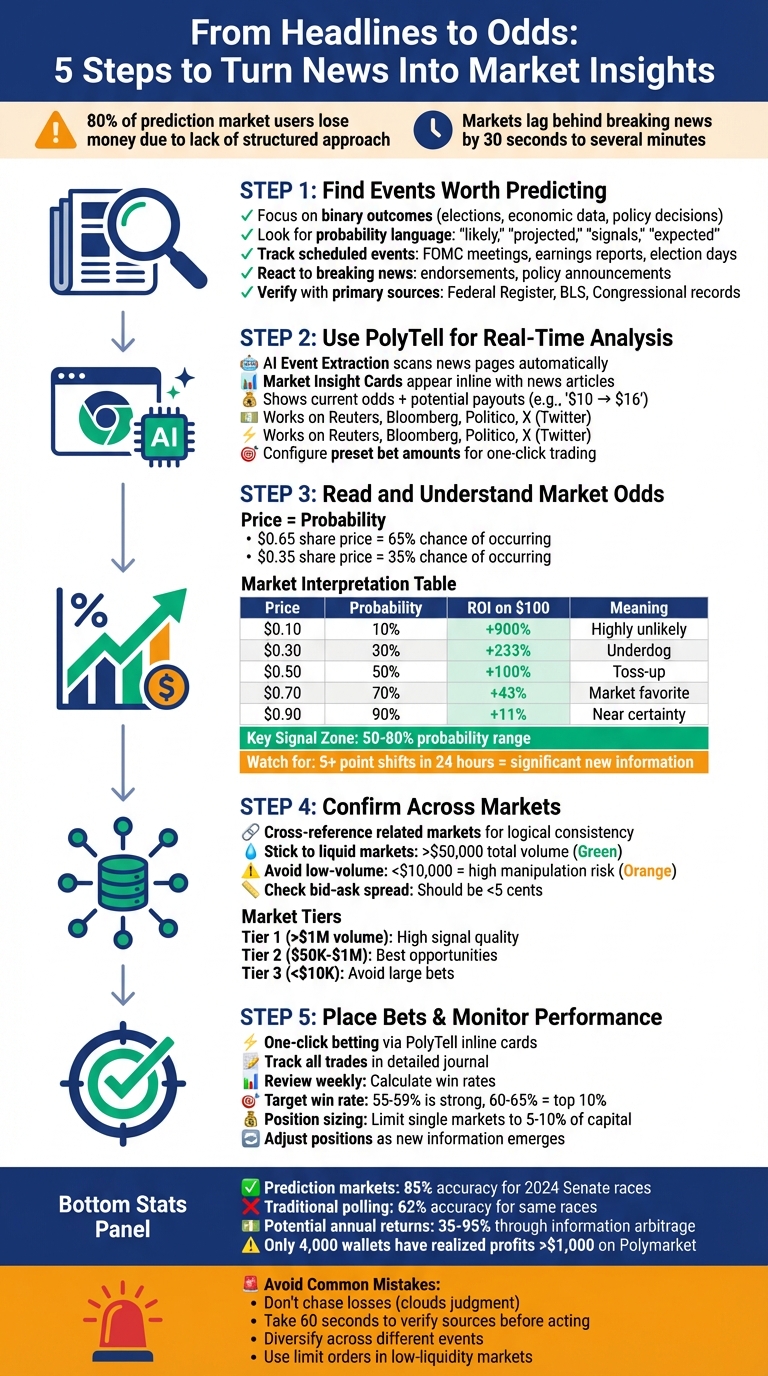
Reading the news can do more than keep you informed - it can help you profit. Prediction markets often lag behind breaking news by 30 seconds to several minutes, creating a small window to act on fresh information. But here’s the catch: 80% of prediction market users lose money because they lack a structured approach. The solution? Tools like PolyTell, an AI-powered Chrome extension, let you analyze news in real-time and match it with live market odds, enabling faster, smarter decisions.
Here’s how to turn news into actionable insights:
- Spot Predictable Events: Focus on news with binary outcomes (e.g., elections, economic data, policy decisions).
- Analyze Language: Look for keywords like \"likely\", \"projected\", or \"signals\" to identify high-impact stories.
- Verify Sources: Cross-check facts quickly to avoid acting on false information.
- Leverage PolyTell: Use its prediction cards to see market odds directly in your news feed and place bets instantly.
- Understand Odds: Market prices reflect probabilities (e.g., $0.65 = 65% chance). Track shifts and volume for better insights.
Step 1: Find Events Worth Predicting in News Stories
The key to turning news into profitable market predictions lies in identifying events with clear, measurable outcomes. These are stories with binary resolutions - events that end with a definitive \"Yes\" or \"No.\" Think elections (will the candidate win?), economic data releases (will inflation exceed 3%?), or policy decisions (will the Senate pass the bill?).
Some of the most valuable events to track include elections at all levels (federal, state, international), economic reports like CPI and GDP numbers, and major policy actions such as Supreme Court rulings or Federal Reserve decisions. For example, in February 2025, Senate Majority Leader Chuck Schumer secured 64 votes for a bipartisan border security package. Since this was enough to break a filibuster, traders could confidently predict the bill’s passage before the Thursday floor vote.
Scheduled vs. Breaking News
Understanding the difference between scheduled and breaking news is critical. Scheduled events, like FOMC meetings, earnings reports, or election days, allow you to prepare predictive models in advance. Breaking news, on the other hand, requires quick responses. For instance, when Robert F. Kennedy Jr. endorsed Donald Trump in 2024, prediction markets adjusted almost instantly, while traditional polls lagged for weeks, still listing him as a candidate.
Recognizing Probability Language
News often hints at predictable events through certain keywords. Look for phrases like \"expected\", \"likely\", \"projected\", \"signals\", or \"within [X] days.\" These terms suggest future outcomes that can be quantified into predictions.
For instance, in early 2025, Reuters reported that Federal Reserve Chair Jerome Powell \"signaled\" interest rates would remain elevated after January inflation hit 3.1%, exceeding the 2% target. This language immediately impacted market odds on rate cuts before July 2025. Similarly, political stories with phrases like \"secures [X] votes\", \"midnight deadline looms\", or \"race to avert\" highlight high-stakes decisions with clear outcomes.
Pay attention to outcome-oriented language in headlines. Words like \"BREAKING\", \"EXCLUSIVE\", or \"CONFIRMED\" often precede market-moving stories. Economic reports using terms like \"hawkish\", \"dovish\", or \"unexpected\" signal potential volatility. For elections, phrases such as \"snap election\", \"record-breaking turnout\", or \"toss-up\" point to competitive races worth monitoring.
Once you identify these cues, verify the information to ensure your insights are based on reliable data.
Verify Facts with Multiple Sources
After spotting potential events, the next step is to confirm their legitimacy by cross-checking multiple sources. While speed is crucial, accuracy is even more important. Markets reward those who can separate real signals from noise, so verifying information quickly is essential.
\"Immediately after any major news event, spend 60 seconds verifying the source before acting. Satire sites, unverified tweets, and premature reports can look like legitimate signals and cause expensive mistakes.\" - VPN07 Speed Trading Guide
Focus on primary sources whenever possible. For example, instead of relying on social media updates, consult the Federal Register for regulatory changes, the Bureau of Labor Statistics for economic data, or official Congressional records for legislative updates. In early 2026, when U.S. military operations in Venezuela began, markets reacted sharply to official airspace directives published on government websites, significantly affecting predictions about Nicolás Maduro’s hold on power.
Cross-referencing is also vital to avoid overreactions. Markets often overcorrect based on a single news item, only to stabilize later. By checking multiple independent feeds, you can distinguish between legitimate market shifts and temporary panic. This disciplined approach can lead to annual returns between 35% and 95% through information arbitrage, separating skilled traders from the rest.
Step 2: Use PolyTell to Analyze News in Real Time
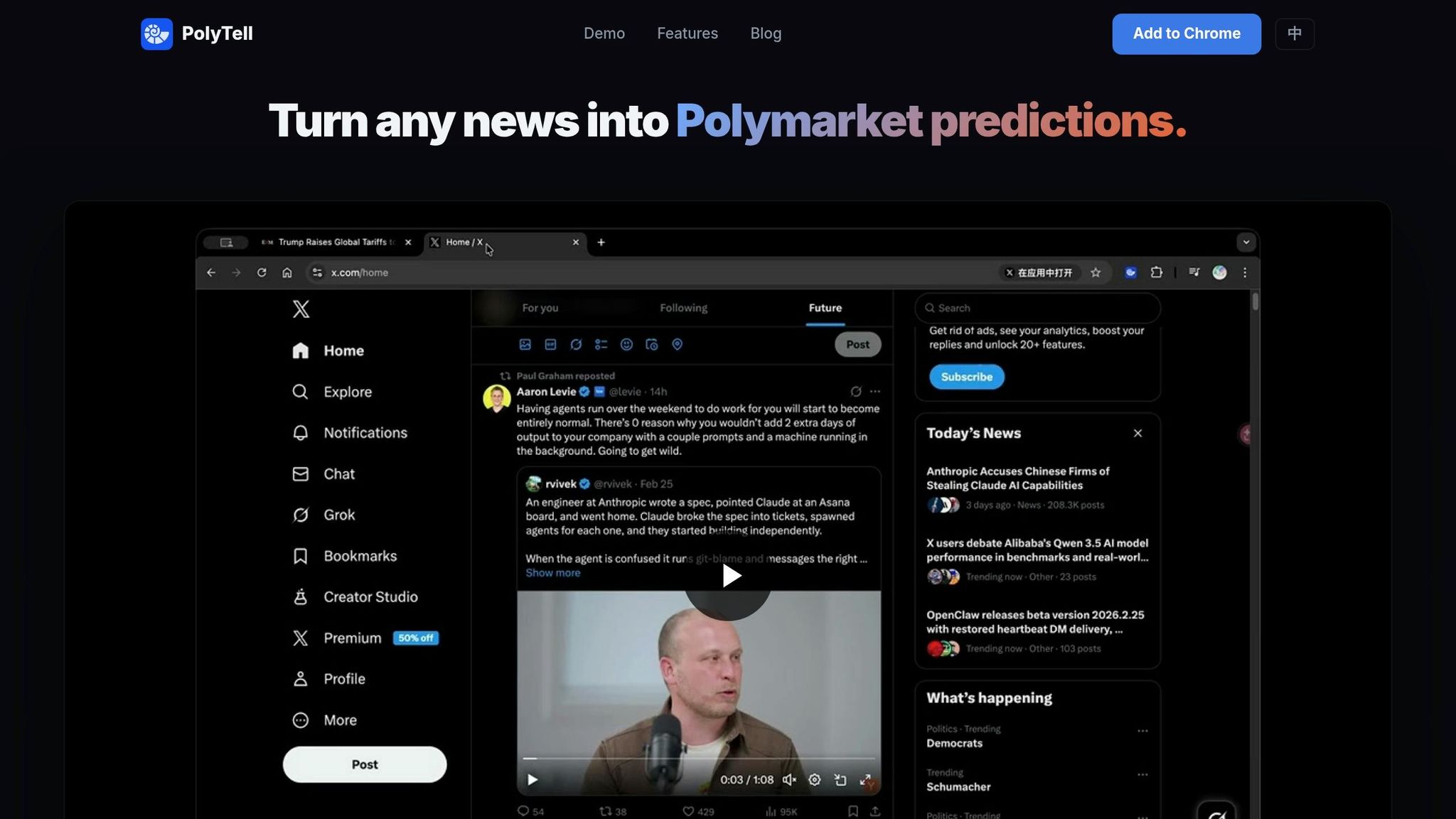
After honing your event-spotting skills, PolyTell takes things up a notch by transforming news headlines into actionable market insights - instantly. Instead of manually searching for relevant data during breaking news, PolyTell extracts events and displays matching Polymarket odds right on the page. This seamless integration connects your news consumption directly to live market data.
Install and Set Up PolyTell
Start by downloading PolyTell from the Chrome Web Store. Once installed, you can immediately begin viewing odds while browsing news sites. The extension works across platforms like Reuters, Bloomberg, Politico, and even social sites like X (formerly Twitter). You’ll notice an icon in your browser toolbar, which you can use to manually analyze pages or toggle between English and Chinese.
Once set up, the next step is understanding how PolyTell’s AI extracts market-relevant events in real time.
How AI Event Extraction Works
PolyTell’s AI taps into a specialized API (api.polytell.app) to process large amounts of text on any given page. It filters out unnecessary elements like navigation menus and UI clutter, focusing solely on core events. These events are then matched with live Polymarket contracts, and Market Insight Cards are embedded directly under relevant paragraphs.
For platforms with infinite scrolling, such as X, PolyTell uses Dynamic Incremental Crawling to continuously scan and analyze new content as you scroll. During a February 2026 demo, the tool analyzed an X timeline and generated 10 specific betting recommendations spanning technology, politics, and business categories. Each card includes the market question, current odds, and potential payouts (e.g., \"$10 → $16\"), allowing you to decide without leaving the page.
Configure Your Bet Amounts
In prediction markets, timing is everything - especially during breaking news when odds can shift in minutes. PolyTell’s inline cards streamline decision-making with \"Buy Yes\" and \"Buy No\" buttons, enabling you to place trades directly from the news page. You can preset your preferred bet amount in the extension’s settings, ensuring it appears on every card for quick action.
If you need more details before committing, each card includes a direct link to the full Polymarket trade page. To stay efficient during major news events, focus on markets with over $50,000 in volume. Smaller markets (fewer than 500 daily contracts) can experience random swings of 3% to 7%. For even faster navigation, consider pinning 5–10 active Polymarket tabs in your browser during high-activity periods.
Step 3: Read and Understand Market Odds
Now that we've covered real-time event extraction, let's dive into how to interpret the market odds displayed by PolyTell. The principle here is straightforward: the price equals the probability. For example, if a share trades at $0.65, that reflects a 65% chance of the event happening. Similarly, $0.35 indicates a 35% likelihood. In essence, the market price directly represents the predicted probability.
Understanding PolyTell's Prediction Cards
PolyTell's prediction cards are packed with useful insights, presenting three key details: the market question, current odds, and potential payout. For instance, if a card shows \"$10 → $16\", it means placing a $10 \"Yes\" bet at the current odds would return $16 if the prediction proves correct.
For a more precise probability estimate, focus on the mid-price - the average of the bid and ask prices. This approach smooths out temporary fluctuations caused by individual trades, offering a steadier view of the market.
Keep an eye on the 24-hour delta as well. A noticeable shift in probability, like a 5-point change within a single day, signals the arrival of significant new information. For example, during President Joe Biden's July 2024 press conference, his nomination odds on Polymarket surged from 33% to 51% within minutes as traders reacted to his live remarks. Meanwhile, Vice President Kamala Harris's odds shifted between 37% and 42% during the same period. These rapid changes highlight how prediction markets adapt to breaking news faster than traditional analysis.
| Market Price (YES) | Implied Probability | Potential ROI (on $100) | Market Interpretation |
|---|---|---|---|
| $0.10 | 10% | +900% | Highly unlikely / Tail risk |
| $0.30 | 30% | +233% | Underdog / Watch for moves |
| $0.50 | 50% | +100% | Toss-up / Maximum uncertainty |
| $0.70 | 70% | +43% | Market favorite |
| $0.90 | 90% | +11% | Strongly priced in / Near certainty |
This table illustrates how odds and potential ROI combine to signal market confidence. Beyond static probabilities, shifts in market prices provide a window into evolving public sentiment.
Tracking Public Opinion Through Market Movements
Market odds aren't just numbers - they're a real-time reflection of public sentiment. Probabilities between 50% and 80% fall into the \"key signal zone\", where even small movements can indicate meaningful shifts in consensus. On the other hand, probabilities above 80% suggest the outcome is \"strongly priced in\", meaning traders overwhelmingly expect it to happen. Any reversal at this stage would likely trigger significant market reactions.
\"A move from 62% to 71% in 24 hours means something changed. If you are not tracking overnight moves, you are showing up late.\" - PredictionBrief
Volume is just as important as price. A noticeable probability shift accompanied by trading volume 3 to 5 times higher than the 7-day average signals strong conviction among traders. In contrast, low-volume price changes often indicate noise rather than real sentiment. To ensure market odds reflect genuine opinions, look for markets with robust trading volume - generally over $50,000.
Step 4: Confirm Your Analysis Across Markets
Once you've analyzed the odds, the next step is to verify your findings by cross-referencing signals across related markets. This isn't just about double-checking facts - it's about ensuring that the signals you're acting on align logically across different but connected markets. By doing this, you can avoid falling for misleading signals and identify mispriced opportunities before they become widely recognized. Cross-market confirmation strengthens your strategy, turning news into actionable insights.
Compare Related Markets
Markets that are connected should logically align in their pricing. For instance, if a candidate has a 60% chance of winning a primary, their odds of winning the general election shouldn't exceed that, since winning the primary is a prerequisite for the general election. Look for discrepancies, such as state-level markets suggesting probabilities that don't match national trends. A real-world example occurred during the 2024 U.S. Presidential election, where state-level markets implied national probabilities that were off by 6% compared to the main market on October 28, 2024.
Additionally, in multi-outcome markets, the combined \"YES\" prices should approximate 100% (or $1.00). Deviations from this can signal arbitrage opportunities. For example, on November 4, 2024, a major election market's outcome prices summed to 103%, presenting a 3% arbitrage opportunity. Once you've confirmed logical consistency, shift focus to market liquidity to ensure smooth execution.
Avoid Low-Liquidity Markets
Liquidity plays a crucial role in determining the reliability of market signals. Stick to markets with at least $50,000 in total volume, as these generally provide more accurate pricing. Low-volume markets - especially those under $10,000 - tend to reflect the opinions of a small number of participants and are more prone to manipulation. Thin liquidity also increases costs; avoid markets where the bid-ask spread exceeds 5 cents.
When evaluating market depth, ignore small orders under $100. A 2026 analysis of Polymarket revealed that 63% of visible orders under $100 were manipulative, designed to create a false sense of market activity.
| Market Tier | Volume Threshold | Signal Quality | Recommended Action |
|---|---|---|---|
| Tier 1 | > $1,000,000 | High | Trust the signal; execution is safe, though the edge may be smaller |
| Tier 2 | $50,000 – $1,000,000 | Moderate | Best opportunities for informed traders |
| Tier 3 | < $10,000 | Weak | High risk of manipulation; avoid large bets |
For trades exceeding $200, check that the order book can handle your position without causing prices to move by more than 1–2 cents. This ensures that your trade won't disrupt the market or incur unnecessary costs.
Step 5: Place Bets and Monitor Performance
Once you've verified your analysis across different markets, it's time to execute your trades. This step is all about turning your insights into action and building a repeatable system for consistent results. It’s what separates casual observers from disciplined traders who refine their strategies over time.
Use PolyTell's One-Click Betting
When it comes to acting on breaking news, speed is everything. Prediction markets often take 30 seconds to several minutes to reflect new information, leaving a small window to act. PolyTell simplifies this process by cutting the usual 10–20 seconds spent manually searching for markets. With Inline Prediction Cards, the extension places key market details - like the question, current probabilities, and potential payouts - right below relevant news paragraphs or social media posts.
If you've pre-set your bet amount in the extension, you can execute trades instantly by clicking \"Buy Yes\" or \"Buy No\", all without leaving the page. This seamless approach keeps you focused and eliminates the hassle of switching tabs during fast-moving developments.
For breaking news, market orders ensure immediate execution. However, in low-liquidity markets, consider using limit orders to avoid slippage. After placing your bets, the next step is just as important: monitoring your performance.
Monitor Your Bet Results
Tracking your results is where many traders fall short. In fact, 80% of prediction market participants lose money because they don’t have a solid review process. Use the Polymarket Portfolio page to monitor your open positions and keep a detailed trade journal. Document your reasoning, entry prices, and expected outcomes for each trade.
Set a routine to review your performance weekly, calculating your win rates. Then, dive deeper monthly to analyze your return on investment by category - whether it's politics, crypto, or economic data. This helps you pinpoint areas where your expertise gives you an edge. A win rate of 55–59% is considered strong, while 60–65% puts you among the top 10% of traders.
Be ready to adjust your positions as new information emerges. Lock in profits early when prices move in your favor, or cut losses if your initial thesis no longer holds up. Don’t forget: when a market resolves, you’ll need to manually click \"Redeem\" on Polymarket to claim your USDC.e winnings.
Finally, refine your strategy by comparing market probabilities with actual outcomes. For example, if you consistently bet on events with a 25% probability, you should win about 25% of those bets. This kind of disciplined tracking ensures that your news-driven insights translate into a reliable edge in the market.
Common Mistakes and How to Avoid Them
Even seasoned traders aren't immune to losses. In fact, more than 70% of Polymarket users and around 1.5 million wallets are in the red, while only about 4,000 wallets have achieved realized profits exceeding $1,000. Learning from these mistakes can give you a better shot at success.
Pros and Cons of News-Based Predictions
Relying on news for trading insights has its perks and pitfalls. Here's a quick breakdown:
| Benefit | Drawback |
|---|---|
| Access to real-time updates before polls adjust | Markets often lag 30 seconds to several minutes behind primary sources |
| Financial incentives encourage accurate probability signals | Nearly 25% of trading volume involves wash trading, creating misleading signals |
| Prediction markets hit 85% accuracy for 2024 Senate races compared to 62% for traditional polling | Thin markets may not reflect true consensus |
| Transparent on-chain data allows tracking of successful traders | Success in one area (e.g., politics) doesn't guarantee success in others (e.g., sports) |
| Continuous price updates vs. static polls that take days to release | Psychological biases lead traders to overtrade by 45% |
The key takeaway? The market isn't the enemy - it’s the mindset. Treating trading like gambling instead of calculated probability analysis is where many go wrong. Prices reflect collective perception, not absolute truths. A well-known trader, zxgngl, serves as a cautionary tale: after earning $29 million from Trump-related election markets, he lost $3.6 million betting on the Mike Tyson vs. Jake Paul fight.
How to Reduce Risk
To protect your capital, integrate these strategies into your trading routine:
- Position sizing: Limit any single market to 5–10% of your total capital. This lesson was painfully learned by Markitzero, who lost $4.6 million by putting all his funds into a single 2024 presidential election market.
- Use limit orders: Especially in low-liquidity markets, this helps prevent slippage and safeguards your edge.
- Verify news sources: Before acting on breaking news, take 60 seconds to confirm its legitimacy. This simple step can save you from falling for satire or unverified tweets. For example, in July 2025, traders lost millions on the market \"Will Zelenskyy wear a suit before July?\" because they ignored technical resolution rules. Despite wearing a formal jacket, the market resolved as \"No\" since it didn’t qualify as a traditional suit.
Diversification is another critical tool. Spread your bets across different events to avoid overexposure to one outcome. Be ready to exit early when your thesis partially plays out, as late-stage reversals or disputes can erase gains. And above all, resist the urge to chase losses - this can cloud your judgment and lead to even bigger setbacks.
Conclusion
Turning news into actionable market insights doesn’t have to be complicated. By following the five steps from this guide - identifying predictable events, leveraging PolyTell's AI extraction, analyzing market odds, cross-checking across markets, and making disciplined bets - you can create a structured approach that works for anyone. It’s a way to turn everyday news consumption into a strategic advantage.
PolyTell simplifies the gap between reading and trading. Its AI scans your news feed and provides inline prediction cards with live odds, so there’s no need to jump between tabs or platforms. For instance, in February 2025, when TechCrunch announced OpenAI’s $40 billion funding round at a $300 billion valuation, PolyTell immediately generated a prediction card asking, “Will OpenAI maintain a $300B+ valuation through 2025?” It even offered a one-click “Buy Yes” option priced at $0.625. This transforms passive news reading into active decision-making.
Timing and accuracy are critical: Markets often lag 30 seconds to several minutes behind primary news sources, giving quick traders a short window to act. But speed alone isn’t enough - always rely on credible sources before putting money on the line. Stick to liquid markets with over 5,000 daily contracts, as these tend to offer calibration accuracy between 92% and 95%. Additionally, using limit orders can help reduce bid-ask costs.