Polymarket arbitrage is all about spotting price mismatches in prediction markets where "YES" and "NO" shares should always total $1.00. When prices diverge, traders can lock in risk-free profits by buying both outcomes for less than $1.00. The catch? These opportunities last only 2–15 seconds on average, making speed critical.
AI has revolutionized this process by:
- Monitoring multiple markets in real time via fast WebSocket connections.
- Identifying mispricings instantly using machine learning to analyze probabilities and market dependencies.
- Executing trades within milliseconds, leveraging automated systems to act faster than humans.
Apr 2024 – Apr 2025
in early 2026
for top AI bots
Between April 2024 and April 2025, arbitrage traders earned over $40 million, with AI-driven bots dominating the space. Tools like PolyTell further assist by integrating market odds into live news feeds, enabling near-instant reactions. Success now depends on combining AI's speed and precision with tools that reduce delays in decision-making.
How AI Detects Arbitrage: Step-by-Step
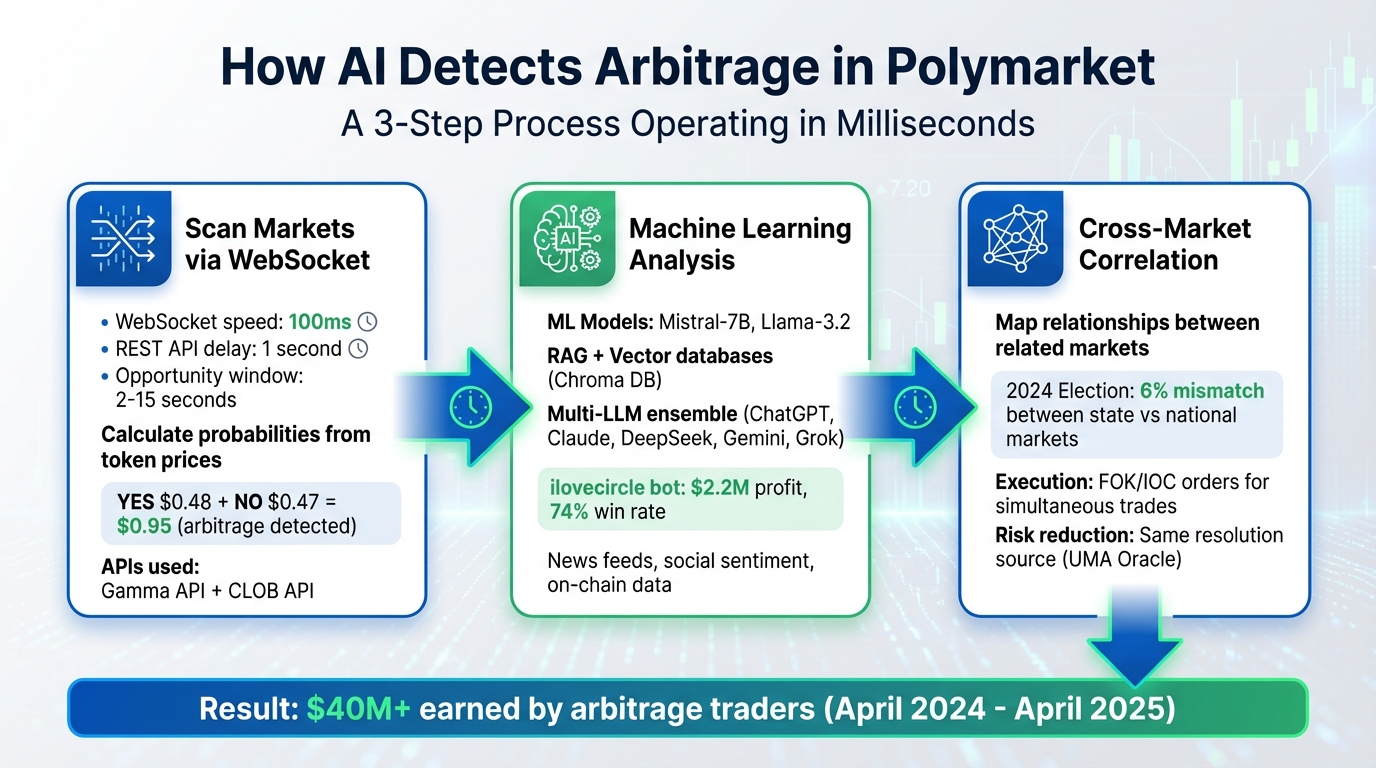
AI systems constantly monitor Polymarket's real-time data to catch brief pricing mismatches. Here's how the process unfolds.
1. Real-Time Data Collection & Market Scanning
AI connects to Polymarket using two key tools: the Gamma API for market metadata and the CLOB (Central Limit Order Book) API for live trading data. The real edge lies in WebSocket connections:
wss://ws-subscriptions-clob.polymarket.com/ws/market
These deliver price updates in as little as 100 milliseconds. In comparison, REST API polling lags behind with delays of about one second — too slow for opportunities that may disappear in 2–15 seconds.
Once connected, the AI calculates probabilities based on token prices. For instance, a YES token priced at $0.65 implies a 65% probability. The system scans for breaches of the "unity constraint", where the combined price of YES and NO tokens strays from $1.00. For example, if YES is $0.48 and NO is $0.47, their total of $0.95 signals a potential arbitrage opportunity.
2. Identifying Inefficiencies with Machine Learning
Speed alone isn't enough — AI must also sift through noise to identify genuine opportunities. Machine learning models like Mistral-7B and Llama-3.2 analyze market descriptions to uncover logical links. For instance, these models can connect a "winning margin" market to a "game winner" market, even if the wording differs.
Advanced bots use Retrieval-Augmented Generation (RAG) and vector databases like Chroma DB to incorporate external context — news feeds, social media sentiment, and on-chain data. A standout example is the "ilovecircle" bot, which earned $2.2 million in profit over two months with a 74% win rate using a neural network to evaluate news and monitor whale flows.
"Arbitrage on Polymarket is not gambling, but engineering. Here, you earn not on predictions, but on the inefficiency of the system itself." — Jeremy Whittaker, Analyst
Professional setups often rely on multi-LLM ensembles to minimize false positives:
| Model | Role |
|---|---|
| ChatGPT | General reasoning |
| Claude | Detailed analysis |
| DeepSeek | Technical pattern recognition |
| Gemini | News analysis |
| Grok | Social media sentiment |
3. Dependency Analysis Across Related Markets
Arbitrage opportunities frequently emerge from inconsistencies between related markets. AI maps these relationships and flags instances where, for example, a candidate's win probability in one market exceeds their party's overall chance.
Take the 2024 U.S. Presidential Election: on October 28, 2024, state-level markets implied national probabilities that differed by 6% from the primary national market. AI identifies such mismatches by tracking correlations between markets, such as national election odds versus probabilities in key swing states.
When a dependency opportunity is spotted, the bot executes all related trades simultaneously using Fill or Kill (FOK) or Immediate or Cancel (IOC) orders to avoid price shifts during execution. The system also ensures related markets share the same resolution source, like the UMA Oracle, to reduce "leg risk."
How AI Optimizes Arbitrage Execution
Spotting opportunities is just the starting point. The real hurdle is executing trades fast enough to lock in profits before the market adjusts.
Position Sizing & Risk Management
AI relies on the Kelly Criterion formula to calculate the ideal percentage of bankroll to risk:
To avoid over-leveraging, bots use a scaled-down fractional Kelly approach (commonly 0.25×). Before executing, AI examines order book depth on both sides — limiting position size by the leg with least liquidity to prevent slippage.
Trades typically incur a 2% winner fee plus Polygon gas expenses, meaning a gross spread of 2.5%–3% is necessary just to break even. Risk is tightly controlled:
- Single-market exposure capped at 5%–10% of bankroll
- Trading halted if the portfolio drops by 5% in a single day
Automated Execution for Speed and Accuracy
While arbitrage opportunities in 2024 lasted about 12.3 seconds, by early 2026 they had shrunk to just 2.7 seconds. High-performance bots now execute trades in as little as 500 milliseconds — well beyond human capability.
Key execution strategies:
- IOC / FOK orders — ensure both legs fill at the desired price or neither executes
- Pre-signed transactions — trigger instantly when a pricing gap is detected
- Low-latency VPS — deployed near Polymarket's API endpoints for sub-50ms response times
On December 21, 2025, developer 0xalberto reported earning $764 in a single day using an automated bot that started with just a $200 deposit.
Using PolyTell for AI-Driven Arbitrage Detection

PolyTell offers a powerful tool for human traders looking to stay competitive. While high-frequency bots dominate automated execution, PolyTell helps bridge the gap by cutting down delays in news analysis. By integrating Polymarket data directly into your browsing experience, it eliminates the need for manual searches — letting you act faster on news-driven market shifts.
Real-Time Event Extraction & Market Matching
PolyTell's AI scans news articles and social feeds to identify key events and instantly matches them with live Polymarket contracts. Whether you're browsing Bloomberg, Reuters, TechCrunch, or scrolling through X (formerly Twitter), the extension works seamlessly.
"PolyTell's AI reads the content, extracts key events, and matches them against live Polymarket markets — all without leaving the page." — fengyiqicoder, Developer of PolyTell
In February 2025, a developer showcased PolyTell on Hacker News, demonstrating how it analyzed an X timeline in real time — generating 10 bet recommendations across tech, politics, and business. It can match up to 5 events within a single article and 10 events on an X timeline.
Inline Prediction Cards with One-Click Betting
PolyTell integrates inline prediction cards directly into the content you're reading. Each card displays the market question, odds, and potential payouts (e.g., "Buy Yes $10 → $14"), along with a one-click bet button for instant action — no tab switching required.
Example integrations in the wild:
- A TechCrunch article about OpenAI's $40B funding round surfaced a market: "Will OpenAI maintain a $300B+ valuation through 2025?"
- A Reuters tweet about the Federal Reserve matched: "Will the Fed cut interest rates before July 2025?"
Since arbitrage windows often last only seconds, the ability to act immediately — without leaving your news source — can be the difference between capturing or missing a profitable opportunity. The extension is free to install and requires no account to get started.
Conclusion
AI has reshaped arbitrage on Polymarket, turning it into a fast, data-driven operation. These systems excel at spotting and seizing opportunities that disappear in seconds. Between April 2024 and April 2025, advanced traders using automated strategies pulled in an estimated $40 million, while only 0.5% of all users earned more than $1,000 in profit.
Tools like PolyTell streamline the process by cutting out manual delays — with inline prediction cards integrated directly into news feeds, traders save valuable seconds. And when arbitrage opportunities last mere moments, shaving off even 5–10 seconds can determine whether you capitalize on a trade or miss out entirely.
In a market where milliseconds count, staying competitive means embracing automation — whether through custom AI bots or tools like PolyTell that bring market intelligence directly to your browser.