Prediction markets thrive on liquidity, and Polymarket's February 2026 stats reveal both growth and challenges:
- $7 billion in total volume for the month, a 7.5× increase from last year.
- Single-day peak: $425 million in trading volume on February 28.
- Liquidity remains uneven: 47% of activity came from 505 high-volume contracts, while 63% of short-term markets saw no trades.
AI tools are reshaping the game. Polymarket uses advanced metrics like Flow-Impact Lambda and Herfindahl-Hirschman Index to analyze liquidity. It also supports AI agents for automated trading strategies. Meanwhile, PolyTell, a browser extension, connects live Polymarket data with breaking news, offering real-time insights directly in your reading experience.
Both platforms cater to different needs: Polymarket excels in deep liquidity and analytics, while PolyTell simplifies news-driven trading decisions. Together, they highlight how AI is transforming prediction markets.
1. Polymarket
Liquidity Metrics
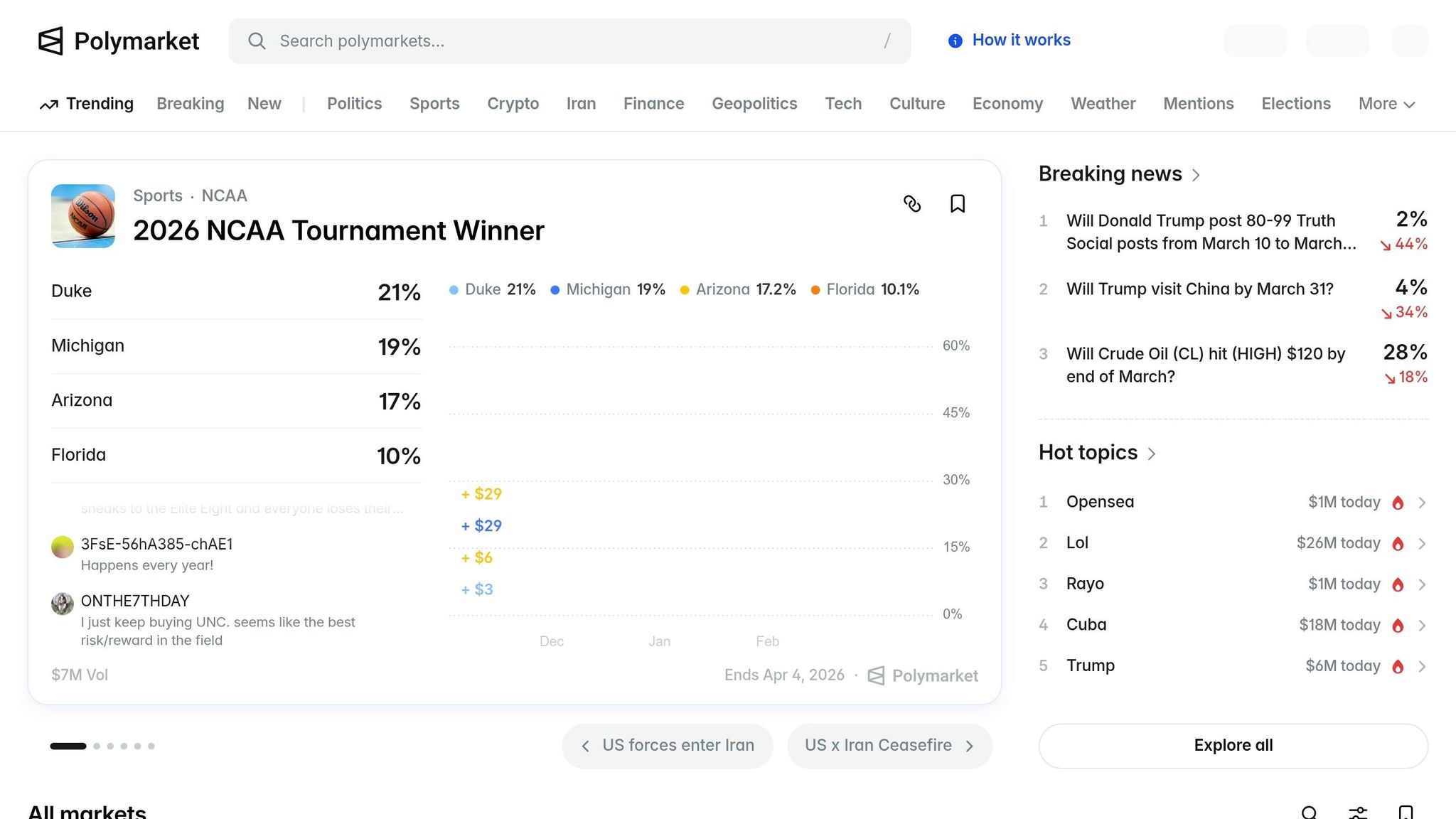
Polymarket's liquidity is heavily concentrated, with a noticeable divide between thriving markets and those that remain inactive. For instance, long-term markets average around $450,000 in liquidity, while ultra-short-term markets operate with a much smaller average of $10,000. This highlights the platform's selective liquidity dynamics.
To better understand market behavior, Polymarket employs advanced metrics beyond basic spreads. The Flow-Impact Lambda measures how much the mid-price shifts (in basis points) per unit of signed taker flow — lower values here indicate markets that recover quickly after large trades. Another key metric, the Herfindahl-Hirschman Index (HHI), assesses liquidity provider concentration. A lower HHI score reflects healthier competition among makers. A notable example occurred on February 17, 2026, when a $70,000 liquidity reward was injected into the "Will Jesus Christ return before 2027?" market. This caused the HHI to drop significantly from 0.164 to 0.041, as the number of active makers jumped from 302 to 639.
"Polymarket is evolving from a 'predict anything' utopia into an extremely specialized financial tool. Value is only discovered where liquidity is abundant; where liquidity dries up, there are only traps." — Frank, Author, PANews
These metrics reflect the platform's focus on leveraging sophisticated tools to enhance its liquidity ecosystem.
AI-Driven Features
Polymarket integrates historical L2 data and API access, enabling traders to create AI agents with frameworks like OpenClaw. These agents automate liquidity strategies with predefined constraints. For example, an agent might hold off on trades if the spread exceeds 60 basis points, allowing traders to simulate order execution before committing capital. Tools like Polyseer further enhance decision-making by analyzing resolution criteria and key data sources, such as FRED indicators and SEC filings. This helps identify mispriced markets where traders may be reacting to headlines rather than underlying probabilities.
In 2025, Polymarket introduced a non-linear taker fee model for crypto markets. This fee structure, based on probabilities, redistributes costs through maker rebates. The result? Average bid-ask spreads in 15-minute crypto markets narrowed from 4.5% in 2023 to 1.2% by 2025. Additionally, bot-driven wash trading dropped from 25% to 5% by May 2025. During the week of February 2–8, 2026, these markets processed 15.3 million on-chain fills worth $153 million, with Bitcoin dominating 19 of the top 20 most profitable wallets.
User Accessibility
Polymarket combines its technical sophistication with a user-friendly experience, making it accessible to a wide range of traders. The platform supports various funding methods, including cryptocurrency, credit/debit cards, and bank transfers. Its tiered interface caters to both beginners and advanced users, offering "simple" and "advanced" modes. Even users who don't actively trade can monitor market sentiment for free, turning Polymarket into a "real-time probabilistic newsfeed" that attracts organic traffic and boosts liquidity.
After acquiring QCEX, a CFTC-licensed exchange, Polymarket launched a regulated U.S. mobile app in December 2025, aiming to attract mainstream retail users. By early 2026, the platform had reached 1.6 million unique users, with 61.48% of them holding positions between $0 and $50. Interestingly, 14.8% of wallets show net realized gains — nearly five times higher than the 3% seen in traditional sports betting.
I Let AI Agents Trade Polymarket for 24 Hours (The Results are Insane)
2. PolyTell
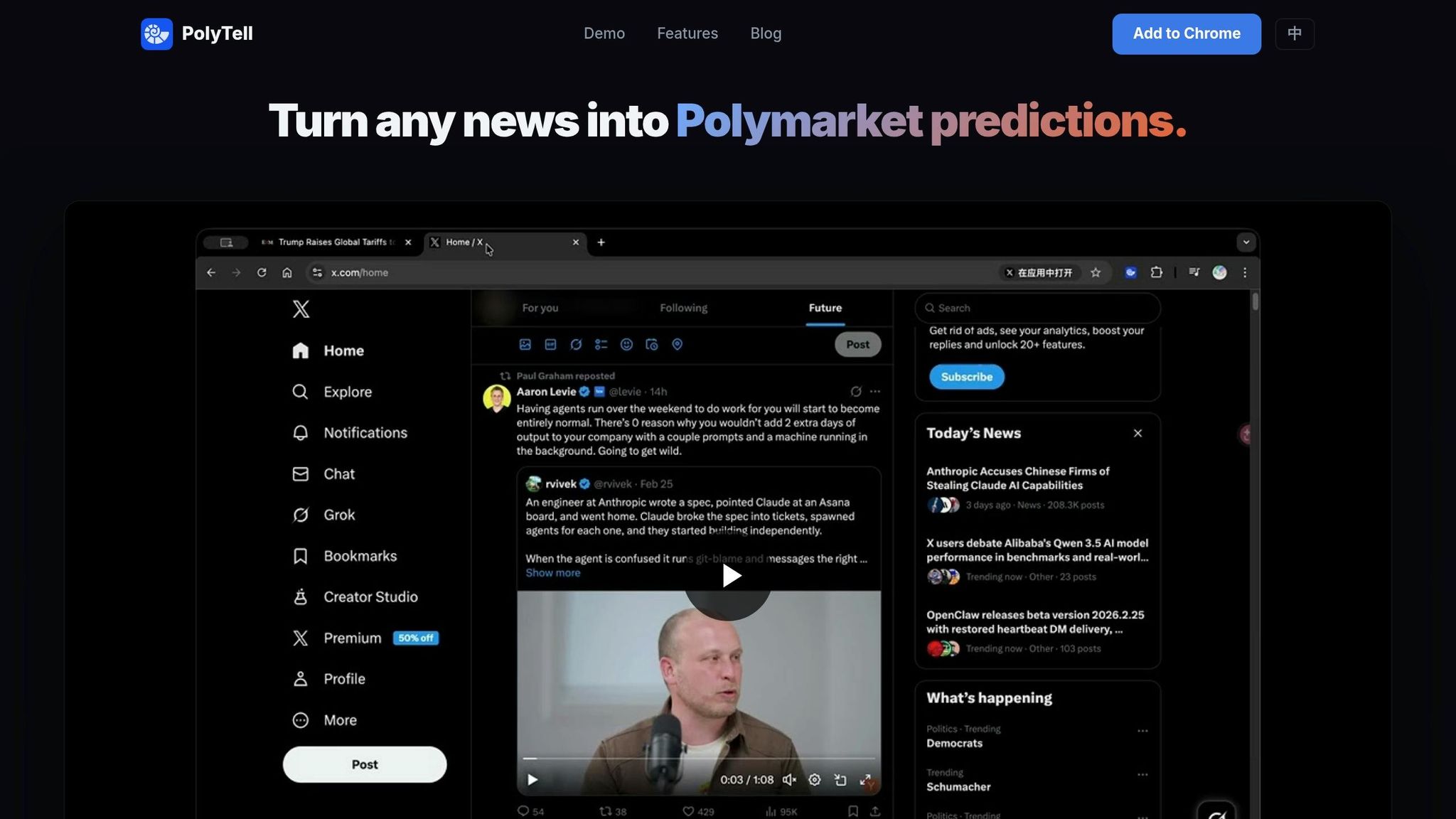
While Polymarket focuses on enhancing liquidity through metrics and AI-driven trading strategies, PolyTell transforms news events into actionable market insights.
AI-Driven Features
PolyTell leverages AI to bridge the gap between breaking news and live Polymarket data. Using its dedicated API, the browser extension scans news articles and social feeds, including platforms like X (formerly Twitter). As you browse, its AI identifies key events and cross-references them with active Polymarket listings. It then provides real-time "Yes/No" odds and even suggests positions based on current market data.
Designed for platforms with infinite scrolling, the extension filters out irrelevant content automatically. This ensures you only see up-to-date market insights without needing to refresh the page or switch tabs.
User Accessibility
PolyTell integrates seamlessly into your reading experience by inserting Market Insight Cards directly into the content flow. Each card includes the market question, current probabilities, and potential payouts — for instance, showing returns like "$10 → $14". A direct link to the corresponding Polymarket trade page is also provided, enabling swift action.
The extension is free to install and doesn't require an account for basic use. It supports both English and Chinese interfaces, making it accessible to a wider audience. By February 2026, the PolyTell Beta extension on the Chrome Web Store had around 50 users. The developer has also mentioned that certain features may require in-app purchases. This setup ensures smooth integration with Polymarket's trading ecosystem.
Market Integration
PolyTell complements Polymarket's detailed liquidity analysis by turning news into actionable trade signals. It works across any news site or language, automatically detecting your browser's language to display relevant prediction cards. The extension continuously syncs content with live Polymarket contracts, delivering precise, in-context insights as you browse.
Pros and Cons
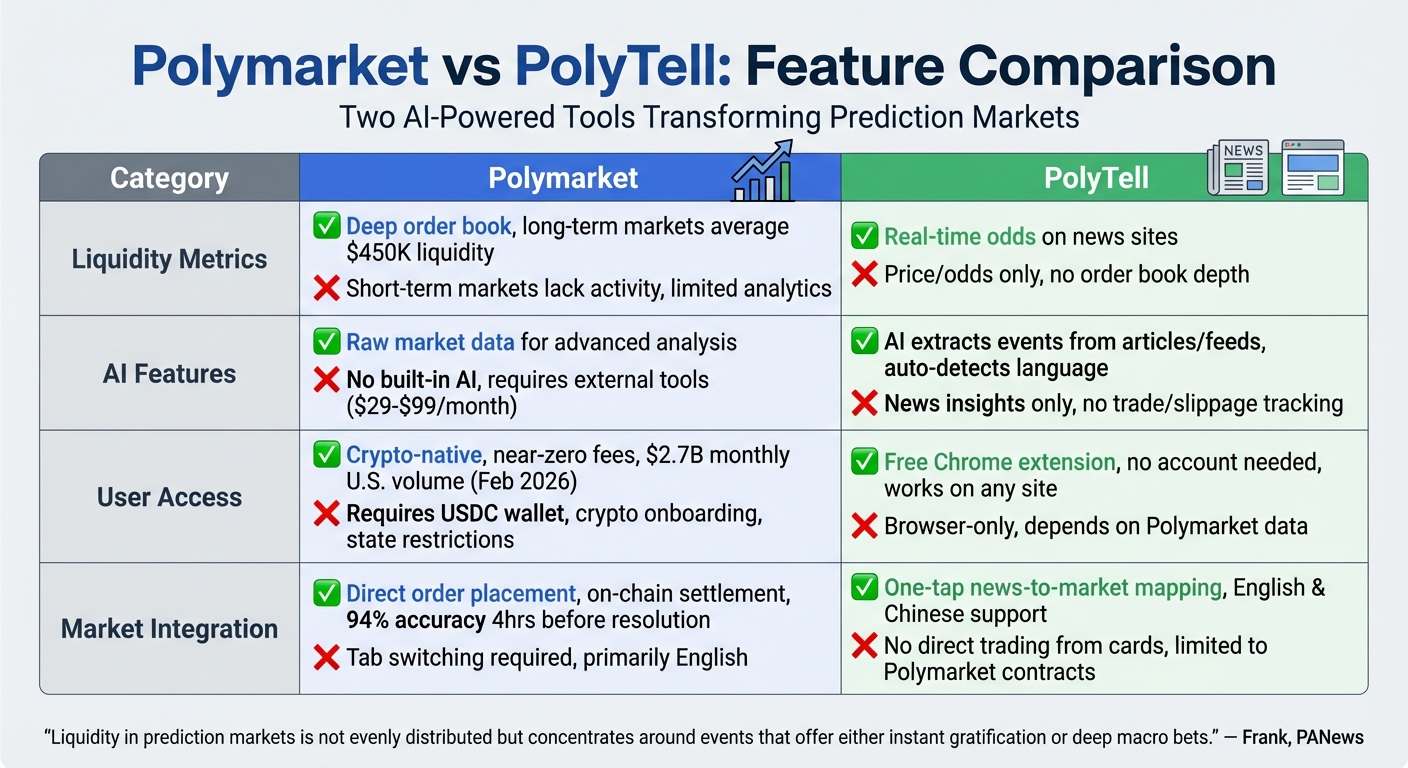
Let's take a closer look at the strengths and challenges of Polymarket and PolyTell, two tools that approach prediction markets in unique ways.
Polymarket stands out with its deep liquidity, handling an impressive $33.4 billion in trades in 2025. On the other hand, PolyTell leverages AI to extract news insights and present inline odds directly on news sites, creating a different kind of user experience.
Here's a breakdown of their pros and cons across four key areas:
| Category | Polymarket | PolyTell |
|---|---|---|
| Liquidity Metrics | Pros: Offers a deep order book with long-term markets averaging $450,000 in liquidity. Cons: Short-term markets often lack activity, and analytics are limited to basic snapshots. |
Pros: Displays real-time odds directly on news sites. Cons: Only provides price/odds data without order book depth. |
| AI Features | Pros: Supplies raw market data for advanced analysis. Cons: Does not include built-in AI capabilities, relying on external tools like PolyTrack ($29–$99/month). |
Pros: Integrates AI to extract events from articles and social feeds, auto-detecting browser language. Cons: Focused solely on news insights; lacks tracking for large trades or slippage. |
| User Access | Pros: Crypto-native with near-zero fees, processing $2.7 billion monthly from U.S. users as of February 2026. Cons: Requires a USDC wallet, crypto onboarding, and is restricted in some U.S. states. |
Pros: Free Chrome extension with no account needed; works seamlessly on any site. Cons: Limited to browser use and depends on Polymarket data. |
| Market Integration | Pros: Allows direct order placement with transparent on-chain settlement; boasts 94% prediction accuracy four hours before resolution. Cons: Requires switching tabs and supports primarily English interfaces. |
Pros: Simplifies news-to-market mapping with one tap and supports English and Chinese. Cons: Does not support direct trading from cards and is limited to Polymarket contracts. |
"Liquidity in prediction markets is not evenly distributed but concentrates around events that offer either instant gratification or deep macro bets." — Frank, PANews
Polymarket excels in delivering detailed market data and depth, making it ideal for those placing large macro bets or analyzing granular details like slippage. Meanwhile, PolyTell offers a different advantage: it brings news-driven opportunities to your fingertips, allowing you to act on insights without switching tabs.
Together, these tools highlight how prediction markets can cater to different needs, whether you're diving into complex data or looking for quick, AI-powered insights on the go. Each plays a distinct role, yet they complement each other in shaping the future of this space.
Conclusion
Polymarket's liquidity trends offer a glimpse into how capital flows within prediction markets. With $7 billion in trading volume across 210,000 markets by February 2026, the platform showcases a system where long-term contracts sustain deep liquidity, while ultra-short-term markets operate with lighter reserves.
On the other side of the equation is PolyTell, which focuses on accessibility and engagement. By integrating AI-powered prediction cards into news articles and social media, it turns casual readers into active participants. For instance, when Polymarket hit a single-day trading volume record of $478 million in March 2026, tools like PolyTell enabled retail traders to act swiftly, transforming breaking news into actionable trades. This synergy between liquidity and real-time insights bridges the gap between market infrastructure and user engagement.
"AI has the potential to dramatically expand the feasible design space for prediction markets by enabling high-quality participation in all of the micro-markets that would be otherwise too small to attract skilled human traders." — Vitalik Buterin, Co-founder, Ethereum
Together, Polymarket and PolyTell create a comprehensive ecosystem for prediction markets. As regulatory frameworks evolve to view prediction markets as "truth machines for price discovery", this pairing is well-positioned to drive the next wave of adoption.
Looking ahead, traders who can process information faster than the market adjusts will have the upper hand. Whether managing $10,000 or $10 million, the strategy remains consistent: prioritize resolution criteria, minimize distractions, and let AI handle the complexity. By embracing AI-driven tools, traders can sharpen their edge in today's increasingly sophisticated prediction markets.