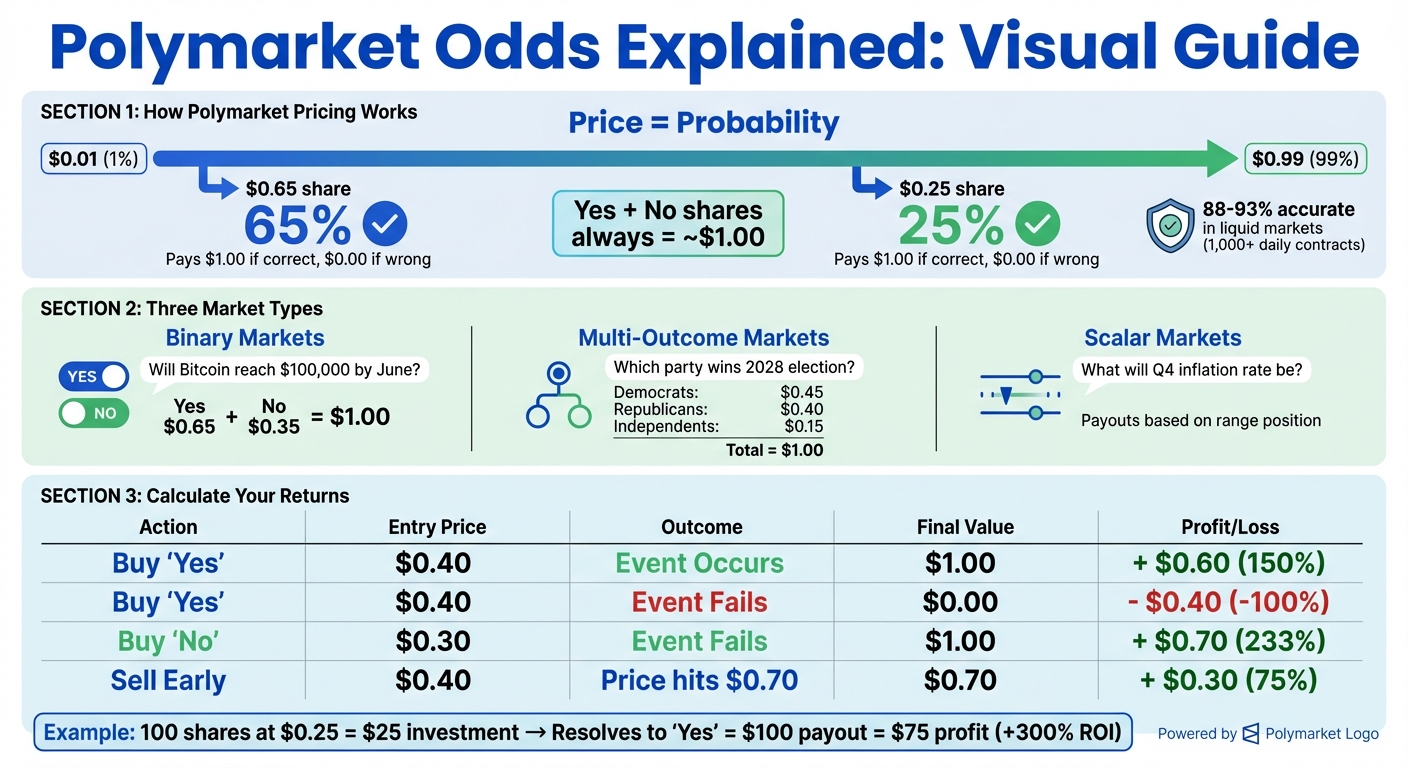
Polymarket is a peer-to-peer platform where you trade predictions on real-world events. Unlike traditional betting, prices on Polymarket represent probabilities — for example, a $0.65 "Yes" share means a 65% chance of the event happening. If correct, each share pays $1.00; if not, it pays $0.00. Key points:
- How It Works: You trade "Yes" or "No" shares based on market prices, which reflect collective probabilities.
- Market Types: Binary (Yes/No), Multi-outcome (multiple choices), and Scalar (range-based outcomes).
- Key Features: Non-custodial (you control your funds), sell shares anytime before resolution, and live prices adjust with new information.
- Accuracy: Liquid markets often predict outcomes with 88%-93% accuracy.
- Tools: Use PolyTell, a browser extension, to track odds directly while reading news.
Start trading by funding your wallet with USDC.e and choosing markets you understand. Focus on liquid markets for better reliability and use mid-prices for accurate probabilities.
What is Polymarket? (Step-by-Step Tutorial)
How Polymarket Odds Work
Polymarket has a simple pricing system where shares are priced between $0.01 and $0.99. These prices directly reflect the market's estimation of an event's probability. For instance, if a "Yes" share is priced at $0.65, the market suggests there's a 65% chance the event will happen. As Polymarket explains:
Prices reflect the market's collective belief in the probability of an event occurring.
Here's how it works: you buy shares at the current market price. If your prediction is correct, each share pays $1.00; if not, it pays $0.00. The potential return depends on the initial price. For example, a $0.10 share could yield a 900% return, while a $0.90 share would result in an 11% return.
Unlike traditional sportsbooks, which include a house edge of 4-8%, Polymarket operates as a peer-to-peer marketplace. There are no hidden fees or margins; prices are determined purely by supply and demand within an order book system. To gauge the most accurate probability, focus on the mid-price — the average of the bid and ask prices — rather than relying solely on the last traded price. This is particularly important in markets with wider spreads.
This system not only reflects the collective sentiment of traders but also provides a clear framework for understanding how odds translate into actionable insights.
What Polymarket Odds Mean
The prices on Polymarket represent the combined predictions of traders who back their opinions with real money. This collective intelligence often leads to well-calibrated probabilities. In active markets with over 1,000 daily contracts, the accuracy of these probabilities typically falls between 88% and 93%, meaning the market's predictions closely align with actual outcomes.
In binary markets, the prices of "Yes" and "No" shares always add up to approximately $1.00. For example, if "Yes" shares are priced at $0.65, "No" shares will be around $0.35. This is because $1.00 of collateral creates one "Yes" share and one "No" share, splitting the dollar between the two outcomes.
Types of Markets on Polymarket
Polymarket offers three main types of markets, each suited to different kinds of predictions:
- Binary markets: These are the most common and feature straightforward Yes/No questions like "Will Bitcoin reach $100,000 by June?" You pick the outcome you believe will happen. These markets work best for events with clear, verifiable results.
- Multi-outcome markets: These allow for multiple, mutually exclusive outcomes. For example, "Which party will win the 2028 Presidential Election?" might have options like Democrats, Republicans, or Independents. The prices of all outcomes combined will total about $1.00. If Democrats are priced at $0.45, Republicans at $0.40, and Independents at $0.15, the market is distributing probability across these options.
- Scalar markets: These are designed for events with a range of possible outcomes, such as "What will the inflation rate be in Q4?" Payouts depend on where the final value falls within the specified range, making these markets ideal for nuanced predictions about economic indicators.
Each market type offers a unique way to engage with predictions, catering to different kinds of events and data-driven insights.
How to Read Polymarket Odds
Converting Odds to Probabilities
Understanding Polymarket odds is simple: the share price directly reflects the market's estimated probability. For instance, a share priced at $0.65 suggests a 65% probability, while one priced at $0.25 indicates a 25% probability.
To get a more accurate sense of probabilities, it's better to use the mid-price — the average of the current buy and sell prices — rather than the last traded price. For example, if "Yes" shares are being sold at $0.66 and bought at $0.64, the mid-price is $0.65. This approach minimizes the impact of the bid-ask spread, especially when the spread exceeds 2 cents.
Once you understand how to translate share prices into probabilities, keep in mind that these odds aren't static — they shift as market conditions and information evolve.
Why Odds Change Over Time
Polymarket odds fluctuate as traders react to breaking news and updated information. When significant news drops, prices can shift by 3–5 cents within minutes as the market adjusts.
Trading volume is a strong indicator of market sentiment. A sharp price increase paired with high trading volume — typically 3 to 5 times the normal level — signals strong confidence in the market's direction. On the other hand, low-volume price movements might reflect the opinions of only a few traders and could reverse quickly.
For example, during a high-profile press conference in July 2024, President Joe Biden's probability of securing the Democratic nomination jumped from 33% to 51% on Polymarket, as traders responded to his performance. Meanwhile, Vice President Kamala Harris's odds briefly dropped to 37% before rebounding to 42%.
As the resolution date for an event approaches, prices often trend toward extremes — either $0.00 or $1.00 — even without new developments. This happens because uncertainty decreases, and traders grow more confident in the outcome. A market hovering around $0.50 might quickly shift to $0.75 or $0.25 as opinions solidify.
The quality of the market also affects how reliable the odds are. In liquid markets with over $50,000 in volume or 1,000+ daily contracts, the probabilities are typically 88% to 93% accurate, closely aligning with actual outcomes. However, thin markets with fewer than 500 daily contracts tend to be less reliable, with calibration accuracy dropping to 70% to 80%, and they may experience random price swings of 3% to 7%.
How to Trade on Polymarket
This section explains how to apply your understanding of Polymarket odds to start trading effectively.
Setting Up Your Wallet and Adding Funds
Getting started on Polymarket is quick and straightforward. You can sign up in one of three ways: through your Google account, via email using Magic Link, or by connecting an existing crypto wallet such as MetaMask, Rabby, or Phantom.
If you're new to crypto, signing up with Email or Google is the simplest option. Polymarket will automatically create a secure wallet for you using Magic Link. Once registered, a Proxy Wallet (a 1-of-1 multisig on the Polygon network) is set up to store your positions and collateral securely. You'll maintain full control of your funds through your private keys.
To begin trading, you'll need to fund your wallet with USDC.e, a stablecoin pegged 1:1 to the U.S. dollar. You can find your wallet address by visiting polymarket.com/settings or by checking the dropdown menu in your profile.
If you're using a Web3 wallet, ensure you have a small amount of POL tokens to cover gas fees. It's also smart to send a test deposit (around $1–$2 USDC) initially to confirm you're using the correct address and network.
Once your wallet is funded, you're ready to dive into trading.
Placing Your First Trade
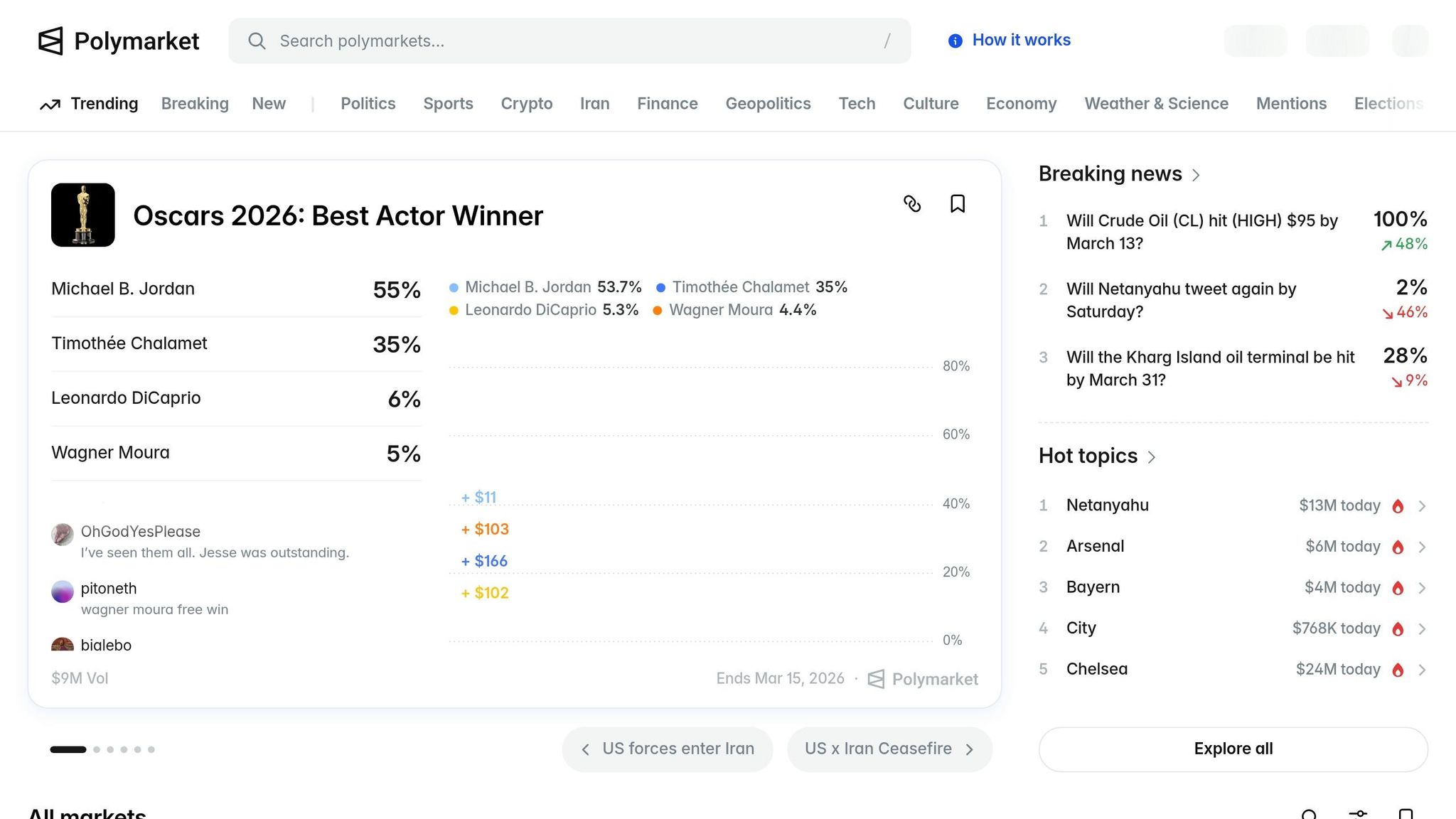
Start by selecting a market — either by searching directly or browsing categories like Politics, Crypto, or Sports. Each market shows current "Yes" and "No" prices, which reflect the market's estimated probability of an outcome.
Before making a trade, check the bid-ask spread. For example, if the spread is 5 cents, you're effectively incurring a 5% cost on a round-trip trade. To minimize costs, consider placing limit orders instead of market orders. Limit orders let you set the maximum price you're willing to pay, helping you avoid unnecessary expenses.
"In prediction markets, the difference between a $0.55 entry and a $0.60 entry on the same position is the difference between a profitable trade and a losing one." — Master Prediction Markets
Here's an example of how returns work: If you buy 100 shares at $0.30 and the outcome resolves to "Yes", you'd pay $30 upfront and receive $100 at resolution. That's a $70 profit, or a +233% return on investment (ROI). Lower entry prices mean higher potential returns, though they also indicate the market sees a lower probability for that outcome.
Tracking Markets and Selling Shares
Once you've placed a trade, managing your positions becomes key. You don't have to wait until the event concludes — Polymarket allows you to sell your shares anytime before the market resolves. This gives you the flexibility to lock in profits or cut losses early. Use the Portfolio page to monitor your active trades and overall performance.
When selling shares, you can choose between market orders for speed — useful during breaking news — or limit orders to set a minimum price and potentially reduce the bid-ask spread cost.
For instance, a trader who bought "Yes" shares at 2.3¢ per share and later sold them at 10¢ enjoyed a significant profit.
If you're selling a large position, check the order book depth first to ensure there's enough liquidity. Without it, you might face slippage, where selling causes the price to move against you. Setting up news alerts can also help you respond quickly to events that could shift market probabilities before others catch on.
How Payouts Work on Polymarket
Now that you've got the basics of setting up and making trades, let's dive into how market outcomes translate into payouts.
How Markets Get Resolved
Polymarket relies on the UMA Optimistic Oracle, a decentralized system designed to verify outcomes without depending on a central authority. Once an event concludes, any user can propose the outcome by staking a bond — usually $750 USDC.e. This bond serves as a security deposit to ensure the accuracy of the proposal.
"Polymarket uses the UMA Optimistic Oracle for decentralized, permissionless resolution. Anyone can propose an outcome, and anyone can dispute it if they believe it's incorrect." — Polymarket Documentation
After a proposal is submitted, there's a 2-hour challenge period where others can dispute the outcome by posting a matching bond. If no one disputes it, the market is finalized, and payouts become available. If someone does challenge it, the dispute is escalated to UMA token holders, who then vote on the correct outcome according to the market's resolution rules. This voting process typically takes 48 to 96 hours, meaning disputed markets may take 4 to 6 days in total to resolve.
Once the market is resolved, you'll need to manually redeem your winnings on the platform. Funds aren't automatically transferred to your wallet — you'll need to click "Redeem" to convert your winning shares into USDC.e.
Now that market resolution is clear, let's look at how to calculate your potential returns.
Calculating Your Profits
After the market is resolved, calculating your profit is straightforward and depends on your entry price and the number of shares you hold. Winning shares are worth $1.00 USDC.e each, while losing shares are worth $0.00 USDC.e.
| Action | Entry Price | Outcome | Final Value | Profit/Loss |
|---|---|---|---|---|
| Buy 'Yes' | $0.40 | Event Occurs | $1.00 | +$0.60 (150%) |
| Buy 'Yes' | $0.40 | Event Fails | $0.00 | -$0.40 (-100%) |
| Buy 'No' | $0.30 | Event Fails | $1.00 | +$0.70 (233%) |
| Sell Early | $0.40 | Price hits $0.70 | $0.70 | +$0.30 (75%) |
For example, if you bought 100 shares at $0.25 and the market resolves in your favor, you'd have spent $25 upfront and receive $100 at resolution. That's a $75 profit or a +300% ROI. Alternatively, you can sell your shares before the resolution to secure gains or minimize losses, as shown in the "Sell Early" example above.
Using PolyTell to Track Polymarket Odds
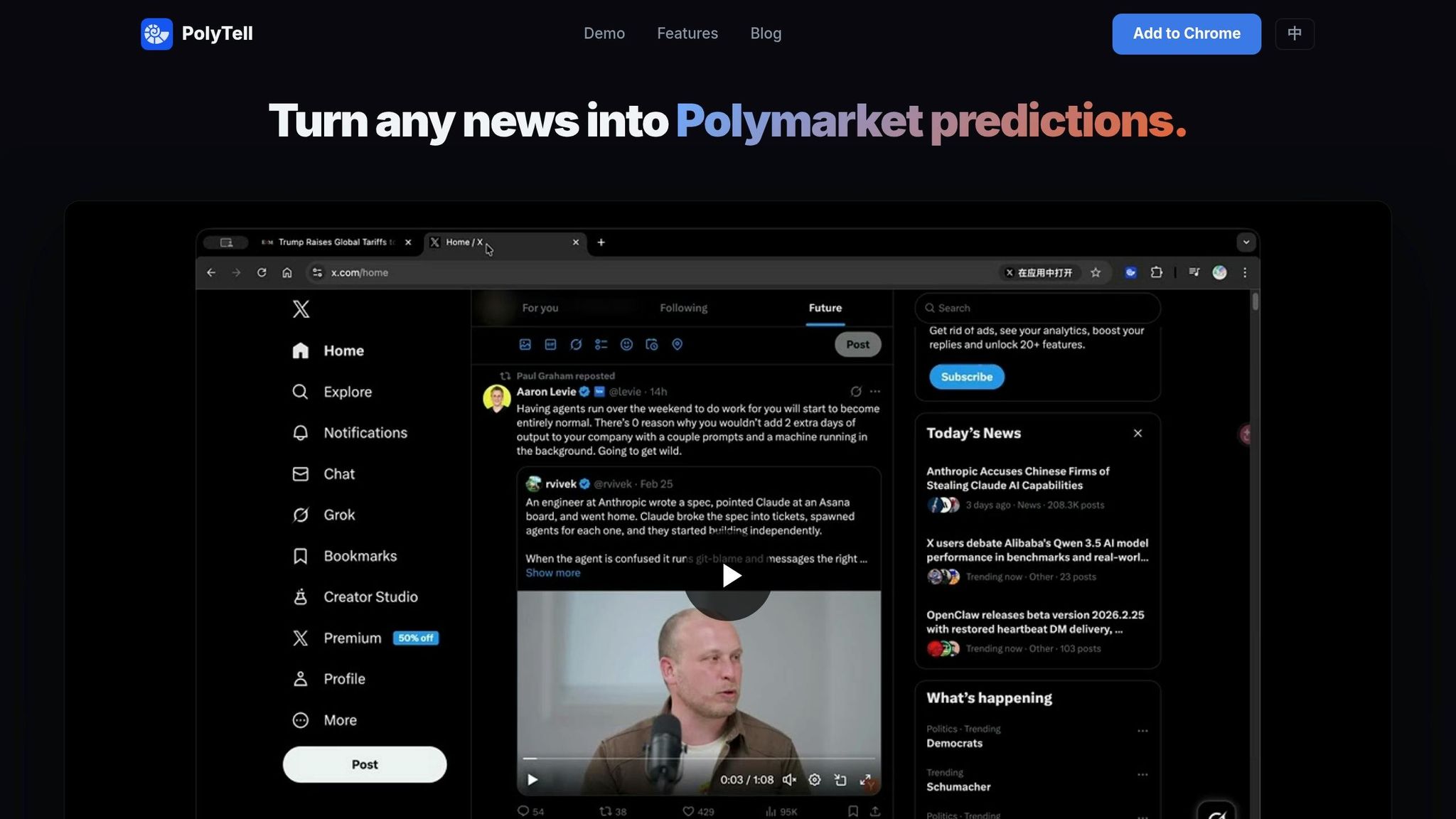
PolyTell takes the hassle out of switching tabs by bringing live Polymarket odds straight into your news feed. This free Chrome extension uses AI to detect events mentioned in articles or feeds, displaying live Polymarket odds right on the page you're browsing. Instead of searching for markets manually, you'll find Inline Prediction Cards beneath relevant paragraphs. These cards show the market question, current probabilities, and one-click betting options, making it easy to act on insights without interrupting your workflow. By integrating with Polymarket, PolyTell simplifies the process of staying updated and making informed decisions in real time.
AI-Powered Event Matching
PolyTell's AI scans text to identify key events and matches them with live Polymarket listings. By filtering out irrelevant details, it focuses on spotting meaningful opportunities for betting. In February 2026, a demonstration highlighted how PolyTell analyzed an X (formerly Twitter) feed, generating 10 specific betting recommendations across categories like tech, politics, and business.
"PolyTell's AI reads the content, extracts key events, and matches them against live Polymarket markets — no need to switch tabs."
- fengyiqicoder, Developer
For platforms with infinite scrolling, such as X, PolyTell uses incremental crawling to quietly analyze new content as you scroll. This ensures you stay updated on emerging markets without lifting a finger. The result? A streamlined experience that allows you to trade directly from the same page you're reading.
Betting Directly from News Pages
Inline Prediction Cards are a game-changer. These cards display the market question, current odds, and potential payouts right on the page. You can even place trades — choosing Buy Yes or Buy No — without navigating away. For instance, while reading an article on The Block about OpenAI infrastructure, PolyTell displayed a widget for a market on an "OpenAI federal backstop." It showed a 5% probability and highlighted a potential return of $1,786 on a $100 bet.
Language Support and Platform Compatibility
PolyTell supports both English and Chinese, automatically adjusting to your browser's language settings or allowing manual switching through its popup menu. It works seamlessly across major news websites like Bloomberg, Reuters, and Politico, as well as social platforms like X. This ensures a unified experience no matter where you consume your news, making informed trading accessible and easy. Best of all, you can install it for free from the Chrome Web Store — no PolyTell account required to start viewing odds and market data immediately.
Key Takeaways
Polymarket operates on a simple principle: price equals probability. Each winning share pays out exactly $1.00, while losing shares become worthless. This straightforward payout system helps you quickly gauge market sentiment and spot opportunities where your predictions differ from the crowd.
When trading, the key is to bet only when your estimated probability is higher than the market's. Also, make sure to carefully review the resolution criteria before placing any bets.
For the most reliable probability signals, focus on highly liquid markets — those with more than 5,000 daily contracts. These markets often achieve calibration accuracy between 92% and 95%, making them a strong choice for informed trading.
To simplify market tracking, you can use PolyTell, a tool designed to deliver live odds directly to your news feed. Instead of jumping between tabs to find relevant markets, PolyTell displays Inline Prediction Cards right on the page you're viewing. These cards show current probabilities and even offer one-click betting options. The AI behind PolyTell scans articles and social media in real time, linking events to live Polymarket listings. Whether you're reading Bloomberg, Reuters, or scrolling on X, PolyTell ensures you stay connected to the markets that matter.
Start small by focusing on markets you know well. Use tools like PolyTell to sharpen your instincts as market reactions unfold. By following these principles, Polymarket becomes a powerful tool for understanding and anticipating future outcomes.