Polymarket and social media are reshaping how we predict events. Polymarket uses financial stakes to create real-time probabilities, while platforms like X (formerly Twitter) provide instant updates and sentiment analysis. Together, they offer a faster, more accurate way to forecast outcomes.
- Polymarket: Predictive accuracy of up to 95.2% before events; adjusts prices within seconds of breaking news.
- Social Media: Delivers instant updates and tracks sentiment through AI, influencing market reactions.
- Integration: Tools like PolyTell streamline access by combining market data with social media insights in real time.
This combination works best when social signals and market odds align — or diverge — revealing potential mispriced opportunities.
1. Polymarket Odds
Accuracy
Polymarket boasts impressive accuracy, reaching 91.1% one month ahead of an event and 95.2% just four hours before resolution. In contrast, traditional polling methods typically fall in the 40–60% accuracy range.
What sets Polymarket apart is its reliance on real money. Traders commit actual funds, which ensures their predictions are backed by genuine conviction, effectively filtering out noise. Interestingly, about 14.8% of Polymarket users profit, a stark contrast to the 3% success rate in traditional sports betting.
This high level of accuracy provides a strong basis for connecting Polymarket's market data with live insights from social media.
Timeliness
Speed is everything in prediction markets, and Polymarket excels here. Prices can shift 15–20% within just 60 seconds of major breaking news. Traders react fast, often analyzing updates and trading within 15–30 seconds of a social media announcement.
Polymarket's partnership with X (formerly Twitter) has further enhanced this responsiveness. Since June 2025, X Cards now display real-time Polymarket odds with latency of less than one second. This instant update capability creates a dynamic feedback loop — news breaks on X, and Polymarket odds adjust in real time.
Ease of Integration
Polymarket offers developers a range of tools to integrate its data seamlessly. These include GraphQL, Gamma REST, and CLOB APIs for market data and trading. For those requiring real-time updates, WebSocket feeds are indispensable, as they provide near-instantaneous price changes. In contrast, standard GraphQL polling can introduce delays.
Tools like PolyTell take integration a step further. This Chrome extension uses Polymarket APIs to embed prediction market data directly into your browsing experience. It pulls key events from news articles and social feeds, displaying inline prediction cards with current Polymarket odds. This eliminates the hassle of manually searching for markets or switching tabs, keeping users updated as news unfolds.
These features ensure Polymarket odds stay tightly aligned with the latest social media activity in near real time.
2. Social Media Signals
Accuracy
AI sentiment analysis has become remarkably precise, capable of understanding subtle nuances in language. For instance, it can interpret a phrase like "growth slowed less than expected" as a positive indicator for the market.
"When you combine AI sentiment analysis of text-based data with prediction market probabilities, you're synthesizing two of the most powerful early-signal systems available."
– MoneySense AI
Another layer of precision comes from whale tracking, which highlights movements by high-value traders. When multiple whales take similar actions, it creates a clear signal for retail traders to follow. A notable example occurred in January 2026 when the AI-powered tool Tweet Oracle predicted Elon Musk's tweet count at 430, achieving a margin of error of just 0.2%. This analysis also revealed a 23% trading advantage within the 420–439 tweet range during the January 20–27 trading window.
These advanced methods offer traders sharper insights, setting the stage for fast market responses.
Timeliness
Social media platforms like X (formerly Twitter) are at the core of rapid market movements. Breaking news shared on X has been known to shift Polymarket prices by as much as 10–20% in mere seconds.
"Twitter (X) is the heartbeat of Polymarket trading. Breaking news, whale alerts, market analysis, and alpha all flow through Twitter before anywhere else."
– AL, Founder of PolyTrack
This speed means opportunities often disappear within minutes as traders react almost instantaneously. Combined with Polymarket's dynamic price adjustments, this quick flow of information significantly boosts prediction accuracy.
Ease of Integration
Polymarket has taken steps to seamlessly incorporate real-time social media data into its platform. Tools like PolyTell make this process even smoother by automating the link between social feeds and prediction markets. Using AI, PolyTell identifies key events from your X/Twitter feed and displays inline prediction cards. This eliminates the hassle of searching for markets or switching between tabs, making the experience more efficient and user-friendly.
Polymarket, Kalshi & Dizzying Rise of Prediction Market Influence
Strengths and Weaknesses
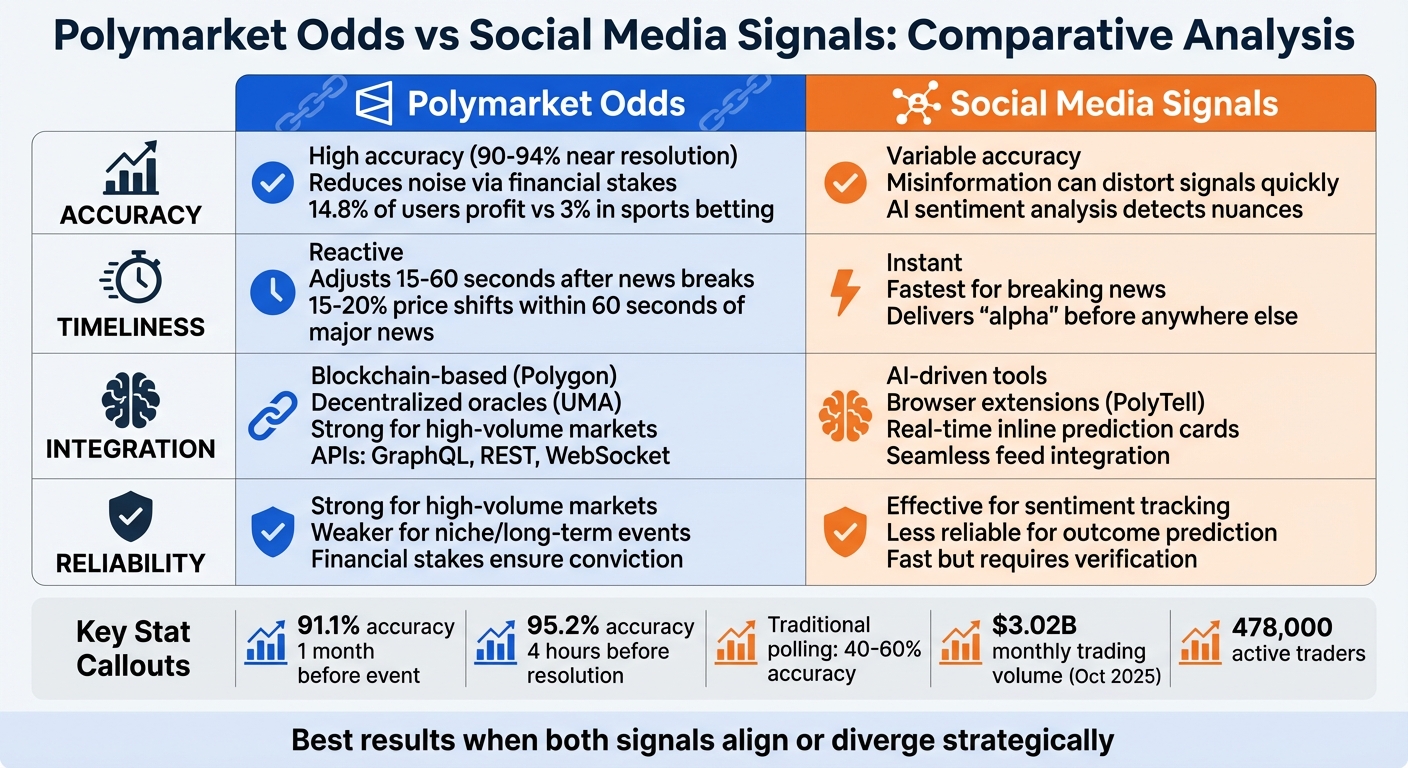
Polymarket odds and social media signals each bring distinct advantages and challenges to the table, offering traders valuable insights when used together.
Polymarket's strength lies in its accuracy, backed by real financial stakes, while social media excels in speed. Because traders invest actual money, Polymarket filters out impulsive reactions and irrelevant noise. Notably, 14.8% of Polymarket users turn a profit, compared to just 3% in traditional sports betting.
Social media, however, leads in timeliness. It delivers breaking news almost instantly, while Polymarket adjusts its prices within 15–60 seconds after news surfaces.
When it comes to integration, the two differ significantly. Polymarket relies on blockchain technology (Polygon) and decentralized oracles (UMA) for transparency in large-scale markets. However, it struggles with distortions in smaller or low-liquidity markets. On the other hand, social media integrates seamlessly with tools like PolyTell, which uses AI to provide real-time insights. With features like inline prediction cards, users can view market data directly in their feed without switching tabs or searching manually.
To better understand their respective strengths, here's a side-by-side comparison:
| Feature | Polymarket Odds | Social Media Signals |
|---|---|---|
| Accuracy | High (90–94% near resolution); reduces noise via financial stakes | Variable; misinformation can distort signals quickly |
| Timeliness | Reactive; adjusts 15–60 seconds after news breaks | Instant; fastest for breaking news and insights ("alpha") |
| Integration | Blockchain-based for transparency in high-volume markets | AI-driven tools and browser extensions for real-time context |
| Reliability | Strong for high-volume markets; weaker for niche or long-term events | Effective for sentiment tracking; less reliable for predicting outcomes |
PolyTell capitalizes on these strengths by combining Polymarket's financial-backed probabilities with social media's real-time updates. Its inline prediction cards provide a streamlined way to access both data sources, enhancing prediction accuracy and usability.
Together, these tools create a powerful forecasting combination. Social media delivers immediate updates, while Polymarket translates those updates into actionable probabilities. As MoneySense AI explains:
"When you combine AI sentiment analysis of text-based data with prediction market probabilities, you're synthesizing two of the most powerful early-signal systems available." – MoneySense AI
This synergy highlights how blending the speed of social media with the precision of Polymarket can significantly improve forecasting reliability.
Conclusion
When combined, Polymarket odds and social media signals create a powerful system for forecasting events. Social media excels at delivering breaking news in real time, while Polymarket translates that news into probabilities backed by financial stakes. The real opportunity lies in identifying moments when these two signals diverge. For example, if social sentiment shifts significantly but market odds stay the same, there may be a mispricing that's worth exploring.
A major milestone in this integration came with the X‑Polymarket partnership in June 2025. By October 2025, this collaboration had driven Polymarket's monthly trading volume to $3.02 billion, with 478,000 active traders. This partnership made prediction data directly accessible through social platforms, eliminating the gap between consuming news and taking action.
Building on this, PolyTell enhances the process by embedding Polymarket odds directly below news articles and tweets as users browse. These inline prediction cards show real-time probabilities and include one‑click betting options. This streamlined setup is essential for capitalizing on fast-moving opportunities.
To maximize accuracy, it's crucial to verify the credibility of social media sources and ensure Polymarket odds reflect these shifts. This alignment helps confirm market trends and sharpens decision-making. Tools like PolyTell simplify this process, allowing users to focus on making informed choices.
By combining the strengths of both sources, their individual limitations are mitigated — social media offers speed and context, while Polymarket provides accuracy and financial validation. Together, they enhance forecasting precision. As MoneySense AI puts it:
"When you combine AI sentiment analysis of text-based data with prediction market probabilities, you're synthesizing two of the most powerful early-signal systems available to non‑institutional investors."