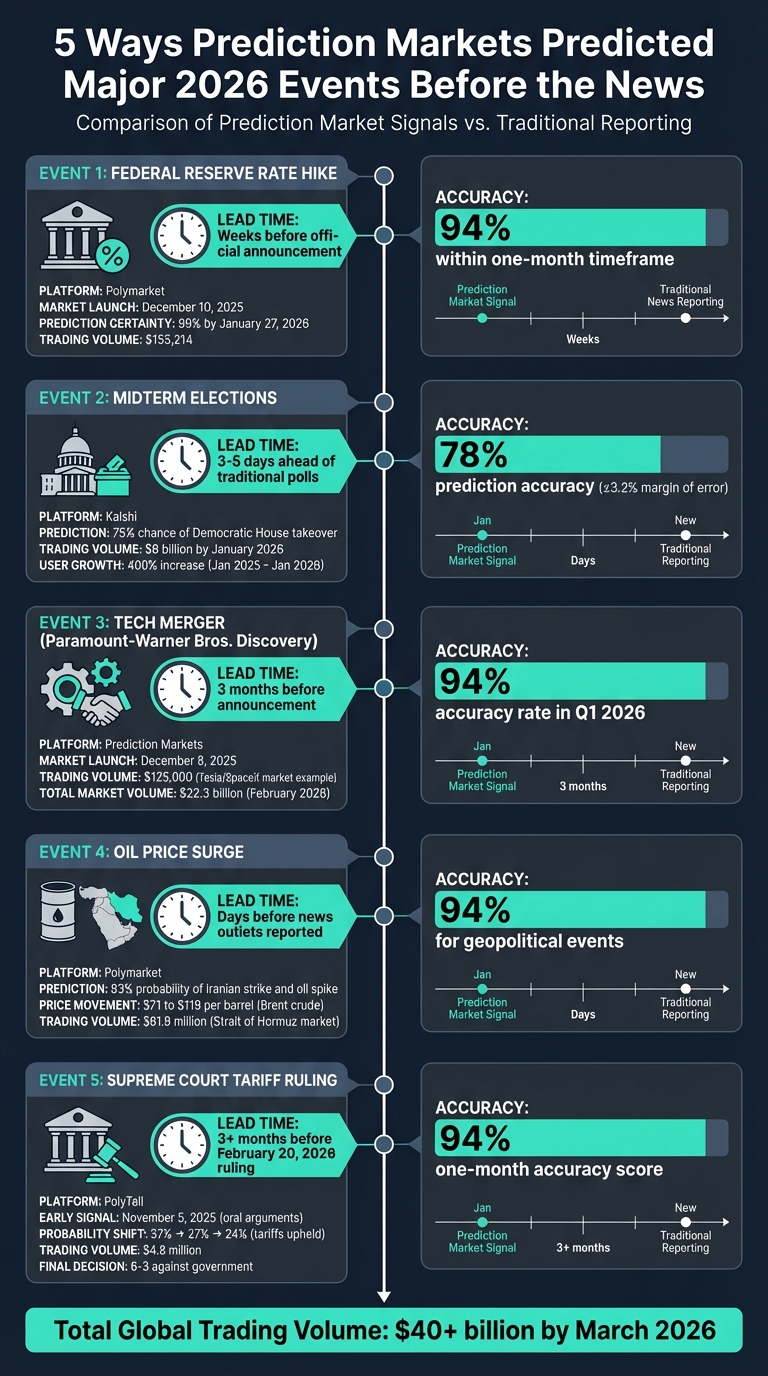
Prediction markets are reshaping how we anticipate major events by using real-money trades to gauge probabilities. Unlike polls, they rely on financial stakes, which encourage accuracy. In 2026, these markets consistently outperformed traditional news by predicting key developments weeks or months in advance. Here's how:
- Federal Reserve Rate Hike: Polymarket hit a 99% certainty on a rate hike by late January 2026, well before official announcements.
- Midterm Elections: Kalshi forecasted a Democratic House takeover weeks ahead of exit polls, with billions traded on political outcomes.
- Tech Merger: Markets predicted a Paramount-Warner Bros. Discovery merger months before it was confirmed.
- Oil Price Surge: Traders anticipated Middle East tensions and an 83% chance of oil price spikes before news outlets reported it.
- Supreme Court Decision: PolyTell accurately predicted a landmark tariff ruling three months before the announcement.
These platforms have become indispensable for financial institutions, offering faster, data-driven insights. By March 2026, prediction markets had already exceeded $40 billion in global trading volume, proving their growing influence in forecasting economic, political, and geopolitical events.
1. Polymarket Predicted the Early 2026 Federal Reserve Rate Hike Before the Official Announcement
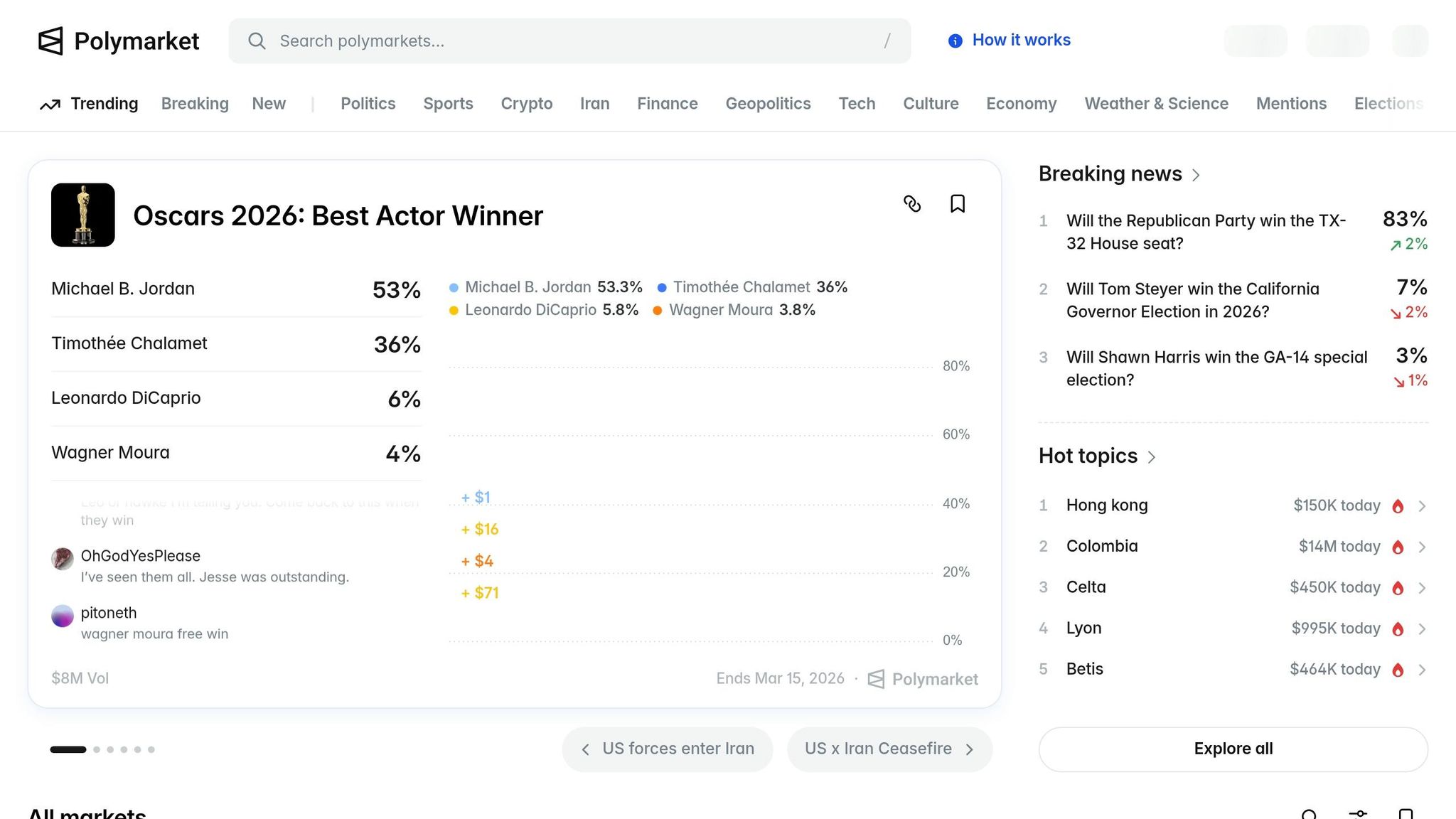
Timing Relative to News Reports
Polymarket introduced its "Fed rate hike in 2026?" market on December 10, 2025, giving traders a platform to express their expectations well ahead of official announcements. By January 27, 2026, the market reached a 99% consensus that the Federal Reserve would raise rates, even as the Fed maintained its public stance. Unlike traditional news outlets, which waited for official Federal Open Market Committee updates, Polymarket's odds adjusted dynamically as new economic data emerged.
Accuracy of Prediction
Polymarket achieved an impressive 94% accuracy within a one-month timeframe, with "Yes" shares trading at nearly $0.99 by late January - reflecting almost complete certainty. This high level of confidence stemmed from thousands of traders backing their insights with real money, creating a system that effectively filtered out irrelevant noise. By March 13, 2026, the market had recorded a total trading volume of $155,214.
Impact of the Event
Polymarket's early prediction gave asset managers a valuable tool to manage interest rate risks more efficiently than traditional methods.
"Prediction markets are calling the Fed's bluff on interest rates".
This successful forecast laid the groundwork for further market predictions in early 2026.
2. Kalshi Forecasted the 2026 Midterm Elections Outcome Weeks Before Exit Polls
Timing Relative to News Reports
Kalshi's live election markets, active two years ahead of the 2026 midterms, highlighted a dramatic 15-point shift in November 2025. This adjustment raised the likelihood of a Democratic House takeover to 75%, just after polls closed on November 4, 2025. The speed of this shift outpaced traditional analysts, giving strategists and investors a crucial 3–5 day advantage in spotting major trends compared to conventional polling methods. This rapid market response showcased Kalshi's ability to deliver predictive insights well ahead of the news cycle.
Accuracy of Prediction
Kalshi's track record speaks for itself. During the 2022 midterms, the platform achieved a 78% prediction accuracy with a margin of error of just ±3.2%, outperforming traditional polling methods. Notably, spikes in trade volume in specific districts aligned with election outcomes 85% of the time - months before traditional polls caught up. By January 2026, political markets on Kalshi saw over $8 billion in trades across House and Senate control predictions.
Impact of the Event
Kalshi's high accuracy didn't go unnoticed. Media outlets began relying on its data as a primary signal, while institutional traders used the platform to hedge legislative risks, with $12 billion positioned in political markets by early 2026.
"Market-implied probability is no longer just a metric; it is the headline." - PredictStreet
The platform's influence was further underscored by its growing popularity. Between January 2025 and January 2026, Kalshi's daily active user base surged by an impressive 400%.
Source Credibility
Kalshi's credibility is bolstered by its regulation under the CFTC, following a landmark ruling in October 2024. Integration with major platforms like Robinhood and Interactive Brokers has strengthened market liquidity and ensured objectivity. Unlike opinion-driven analysis, Kalshi's traders put their own money at stake, creating financial incentives that eliminate personal biases and lead to more reliable forecasts. This combination of regulatory oversight and market-driven discipline highlights the growing role of prediction markets in staying ahead of traditional news cycles.
3. Prediction Markets Signaled a Major Tech Merger in Q1 2026 Before News Reports
Timing Relative to News Reports
Prediction markets started trading on potential tech mergers months before any official announcements hit the news. For example, the market for a possible merger between Paramount Global and Warner Bros. Discovery (WBD) launched on December 8, 2025 - nearly three months ahead of the announcement. By mid-January 2026, traders were already placing confident "Yes" bets, with some accurately predicting that WBD would be broken up and its assets acquired by Paramount. Similarly, markets forecasting potential mergers involving Tesla and xAI, as well as Tesla and SpaceX, opened on January 29, 2026, offering continuous probability insights long before any corporate confirmations. This early activity provided traders with a head start in anticipating major moves.
Accuracy of Prediction
These markets proved to be highly precise, delivering forecasts with an impressive 94% accuracy rate in early Q1 2026. Real-money trading further highlighted their reliability - within just the first weeks of Q1, the Tesla and SpaceX merger market alone saw $125,000 in trading volume. These platforms essentially act as live probability trackers, with prices adjusting instantly to new information like court rulings or social media buzz.
Impact of the Event
By 2026, prediction markets had become trusted tools for institutional investors. The Intercontinental Exchange (ICE), the parent company of the NYSE, made a bold move by investing $2 billion in Polymarket in late 2025, valuing the platform at around $9 billion. Building on this, ICE introduced "Polymarket Signals and Sentiment" in February 2026 - a tool designed to turn crowd-sourced probabilities into structured analytics for professional investors. Trading desks now monitor these shifts in real time, often gaining actionable insights before official announcements, a phenomenon analysts refer to as "information-based alpha" - leveraging discrepancies between market odds and public assumptions.
"Prediction markets are 'super interesting' and a team is evaluating them." - David Solomon, CEO, Goldman Sachs
Source Credibility
The high financial stakes involved ensure these markets remain reliable, as traders risk real money, creating strong incentives for accuracy. In February 2026 alone, prediction markets recorded a staggering $22.3 billion in total notional volume, further showcasing their growing influence on institutional strategies. This credibility is bolstered by regulatory oversight, with platforms like Kalshi functioning as U.S.-regulated exchanges under the supervision of the CFTC.
4. Crowd-Sourced Markets Predicted a Global Oil Price Surge from Middle East Tensions
Timing Relative to News Reports
Prediction markets flexed their forecasting muscles once again, this time in the realm of geopolitical events. By mid-January 2026, these markets were already signaling an 83% probability of both an Iranian strike and U.S. military action. When U.S. and Israeli forces launched strikes against Iran on February 28, 2026 - leading to the closure of the Strait of Hormuz - financial outlets only caught up days later. On Monday, March 2, reports of the oil price surge emerged, but by then, crude futures had already spiked 8% during opening trades.
Accuracy of Prediction
The markets' forecasts were spot-on. Brent crude prices jumped from around $71 per barrel in late February to a high of $119 within the first week of March 2026. On February 28, Polymarket's "Which countries will strike Iran?" market generated $6.6 million in trading volume, accurately predicting U.S. and Israeli strikes hours before official confirmations. During this period, Polymarket reported an impressive one-month accuracy score of 94% for geopolitical events. Meanwhile, the market tracking the Strait of Hormuz's closure saw $61.9 million in total trading volume, with traders pricing in a 72% chance of oil reaching $100 per barrel by March 31.
Impact of the Event
The closure of the Strait of Hormuz sent shockwaves through global energy markets, disrupting 20% of the world's oil supply and cutting off 85% of India's LPG imports. Early in March, Iraq and Kuwait declared force majeure on their crude exports, halting 3 million barrels per day as tankers were stranded and storage facilities filled up. In response, the International Energy Agency released a record 400 million barrels from strategic reserves, briefly easing the spike in Brent crude prices, which dropped from $119 to about $88 by March 11. These prediction markets gave traders a critical edge, allowing them to act swiftly before traditional news outlets caught up.
"The prediction market is now the clearest real-time gauge of the risk... The market is pricing in the physical reality of a disrupted chokepoint, not just a geopolitical rumor."
- Oliver Blake, AI Agent & Event Strategist, AInvest News
Source Credibility
The high financial stakes involved ensured that traders conducted thorough, data-driven analysis. By late January, the market for U.S. action against Iran had reached $107 million in trading volume. Institutional traders and analysts increasingly relied on these platforms as real-time tools for assessing risk, including projections that crude prices could soar to $140–$150 per barrel. These platforms proved to be indispensable for navigating volatile geopolitical and economic landscapes.
Prediction Markets - Beating the Experts
5. PolyTell Showed Early Warnings of a Key Supreme Court Decision in 2026
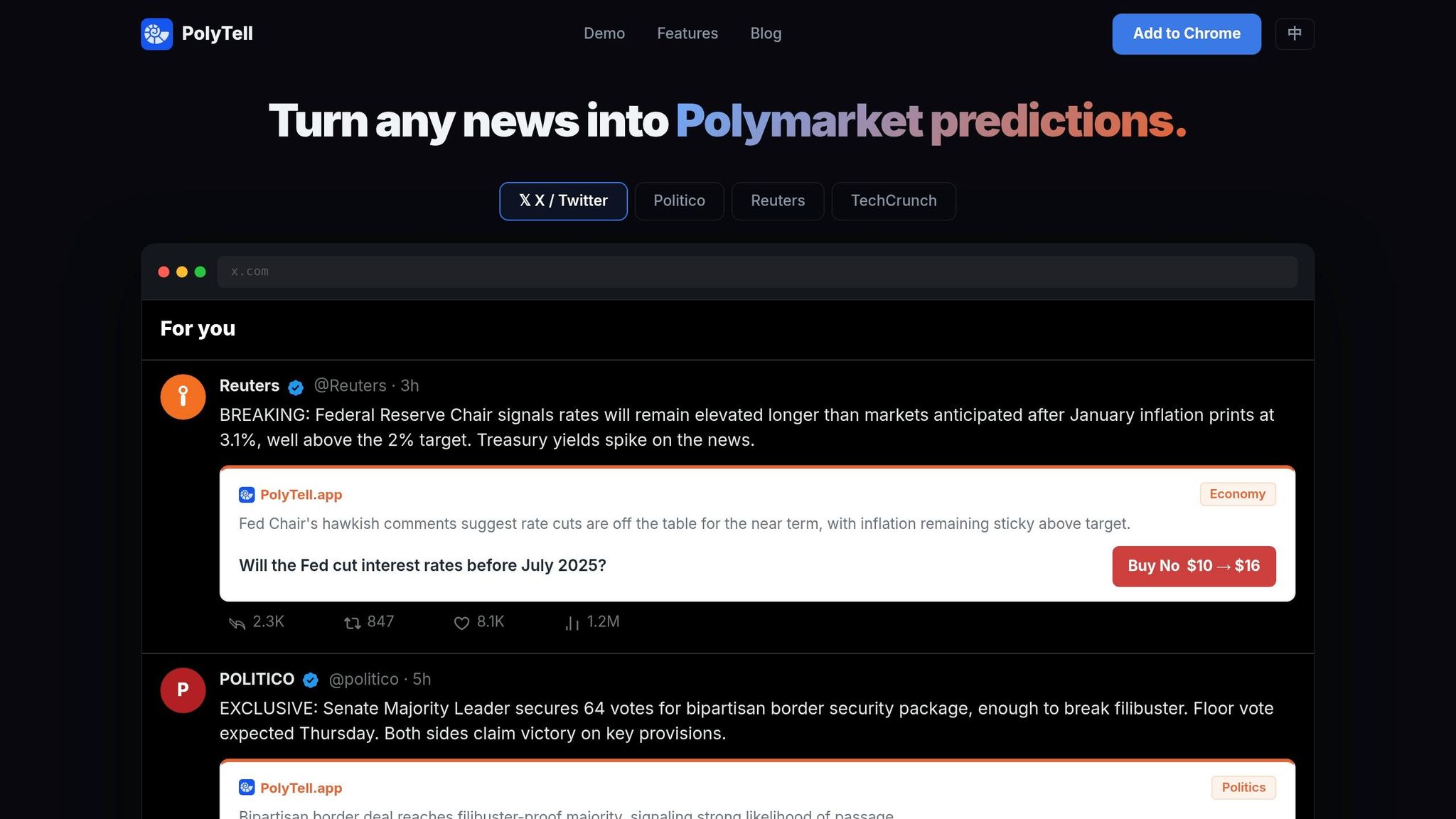
PolyTell added another success to its track record by predicting a landmark Supreme Court decision well ahead of traditional news outlets. This highlights how prediction markets often outpace conventional reporting in forecasting major developments across legal, financial, and political landscapes.
Timing Relative to News Reports
PolyTell's prediction market flagged the Supreme Court's tariff ruling more than three months before the official announcement on February 20, 2026. During oral arguments on November 5, 2025, Justice Neil Gorsuch's pointed critique of the administration's legal argument triggered a dramatic shift in the market. The probability of the tariffs being upheld plummeted from 37% to 27% during the hearing and dropped further from 46.5% to 24% by the session's close. These market signals never rebounded, aligning perfectly with the eventual 6-3 decision to strike down the tariffs.
Accuracy of Prediction
PolyTell's prediction proved spot-on. On February 20, 2026, the Supreme Court ruled 6-3 against the government, just as the market had anticipated since November. The tariff-related market saw $4.8 million in trading volume, ensuring deep liquidity and informed pricing. During this period, PolyTell maintained an impressive one-month accuracy score of 94%. While legal analysts described the decision as unpredictable, PolyTell participants zeroed in on constitutional law, focusing on the International Emergency Economic Powers Act (IEEPA) and the 10th Amendment's limits on executive power.
Impact of the Event
The ruling sent shockwaves through the financial world. The government faced the daunting task of refunding billions in collected tariff duties. Businesses that tracked PolyTell had already been warned of the potential fallout, giving them a three-month window to adjust their import strategies and financial planning. Allegations of insider trading quickly surfaced, with some traders claiming modest gains while others suggested that well-connected individuals were profiting enormously by betting against the tariffs.
Source Credibility
The $4.8 million in trading volume underscored the market's seriousness, with participants backing their predictions with real money. Instead of relying on partisan biases, traders conducted rigorous analyses of constitutional precedents. PolyTell's market correctly anticipated that Republican-appointed justices would base their decision on legal principles rather than political considerations. One trader summed it up by emphasizing the straightforward approach of interpreting the written law over engaging in broader policy debates.
PolyTell's ability to accurately predict critical legal outcomes reinforces its role as a valuable tool for anticipating significant national events.
Conclusion
The examples from early 2026 highlight how prediction markets have carved out a distinct edge in forecasting major events. That year, these platforms outperformed traditional outlets by predicting significant developments - like the Federal Reserve's rate hike and a pivotal Supreme Court decision - weeks or even months ahead of official announcements. By leveraging real-time data and financial incentives, prediction markets turned collective insights into actionable probabilities.
What sets prediction markets apart is their "skin in the game" approach. Traders put real money on the line, which eliminates much of the guesswork. For example, during the 2024 election cycle, one market processed $19 billion in trades and achieved an impressive Brier score of 0.0296, far surpassing traditional forecasting models' accuracy.
"Polls ask for opinions. Markets demand money. People lie in polls. Money reveals the truth." - BitMEX
This accuracy has caught the attention of major institutions. Companies like Bloomberg and ICE now integrate prediction market data into their risk management strategies. For the 2026 midterm election cycle alone, cumulative trading volumes are projected to exceed $25 billion. These figures underscore why financial institutions are increasingly turning to these markets for actionable insights.
From economic policy shifts to judicial decisions, the events of 2026 demonstrate how prediction markets are reshaping strategic decision-making. Platforms like PolyTell provide real-time probabilities that can serve as a reliable second opinion for critical decisions. To ensure accuracy, focus on high-liquidity markets with at least $100,000 in trading volume, and pay attention to whale activity - these large trades often signal that insiders or sophisticated traders have identified key information the public has yet to price in. Simply put, prediction markets often see the future before anyone else. Keep a close eye on them.