Reading the news without checking prediction market data is like navigating with half the picture. News tells you what happened; prediction markets reveal what traders think will happen next, backed by real money. Here's why combining both is crucial:
- Prediction markets provide probabilities. For example, a contract priced at $0.70 means a 70% chance of an event occurring.
- Speed matters. Prediction markets react faster than polls or traditional news, often within seconds.
- Opportunities arise when news and markets disagree. Misaligned probabilities can signal profitable trades.
- Tools like PolyTell simplify the process. They integrate prediction data directly into your news feed, saving time.
For traders, this combination offers a sharper edge: news gives context, markets give actionable probabilities. Together, they help you make faster, better-informed decisions.
The Hidden Math Behind Polymarket, Gambling and Trading
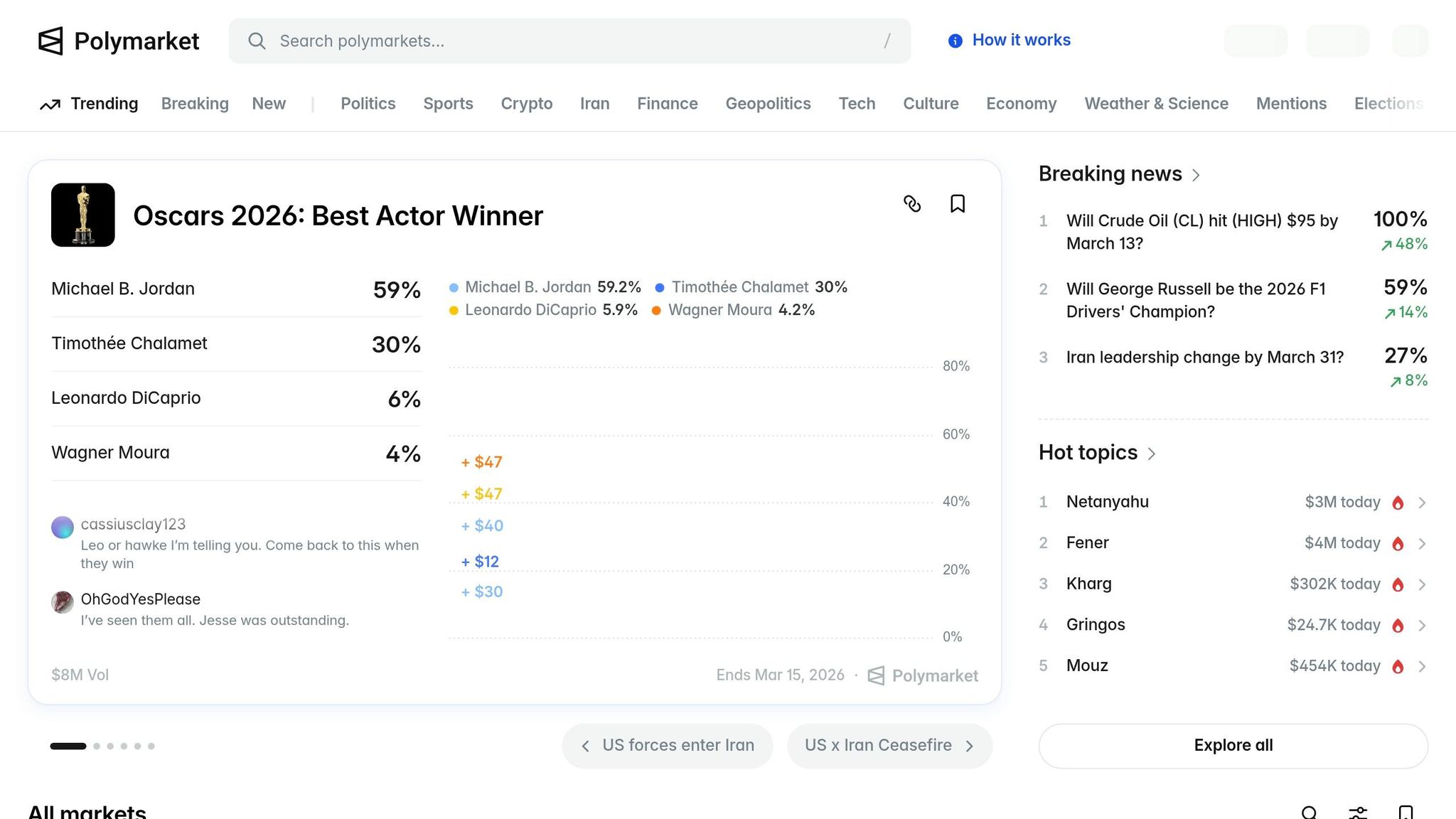
Benefits of Using News and Prediction Markets Together
Using news alongside prediction market data can sharpen trading strategies by providing a clearer, more immediate picture of market dynamics.
Track Market Sentiment and Changes in Real Time
Prediction markets offer a consolidated view of traders' insights, updating probabilities in real time as participants put money on the line. Unlike news, which can lag by hours or even days, prediction markets react within seconds. This creates a dynamic feed reflecting the collective belief of traders who have financial stakes in the outcomes.
The speed of prediction markets is a game-changer. For instance, during the June 2024 presidential debate, Joe Biden's odds in prediction markets started dropping within 15 minutes of the debate's start. In contrast, major polling organizations took nearly two weeks to confirm this shift in sentiment. Watching prediction markets alongside news allows traders to witness these shifts as they happen, avoiding the delays tied to traditional data sources.
"Traders are motivated by profit, not social approval, and will buy shares accordingly, leading to a more honest aggregation of probability." - Kalshi
This real-time data provides a foundation for precise probability assessments, giving traders an edge in decision-making.
Get Probability Numbers for Political and Economic Events
While news headlines often rely on vague terms like "likely" or "uncertain", prediction markets provide a specific probability figure. For example, a contract priced at $0.62 directly translates to a 62% chance of the event occurring. This level of precision is invaluable for traders who need concrete numbers to guide their decisions rather than relying on intuition.
Take the 2024 U.S. presidential election as an example. On November 4, a leading prediction market pegged Donald Trump's chances of winning at 57%, while polling averages hovered around 50%. With over $3.5 billion in trading volume backing this assessment, the market's forecast proved more accurate than traditional polling. Research supports this, showing that prediction markets outperformed polls 74% of the time when compared at similar points before an election.
Find Arbitrage Opportunities When News and Markets Disagree
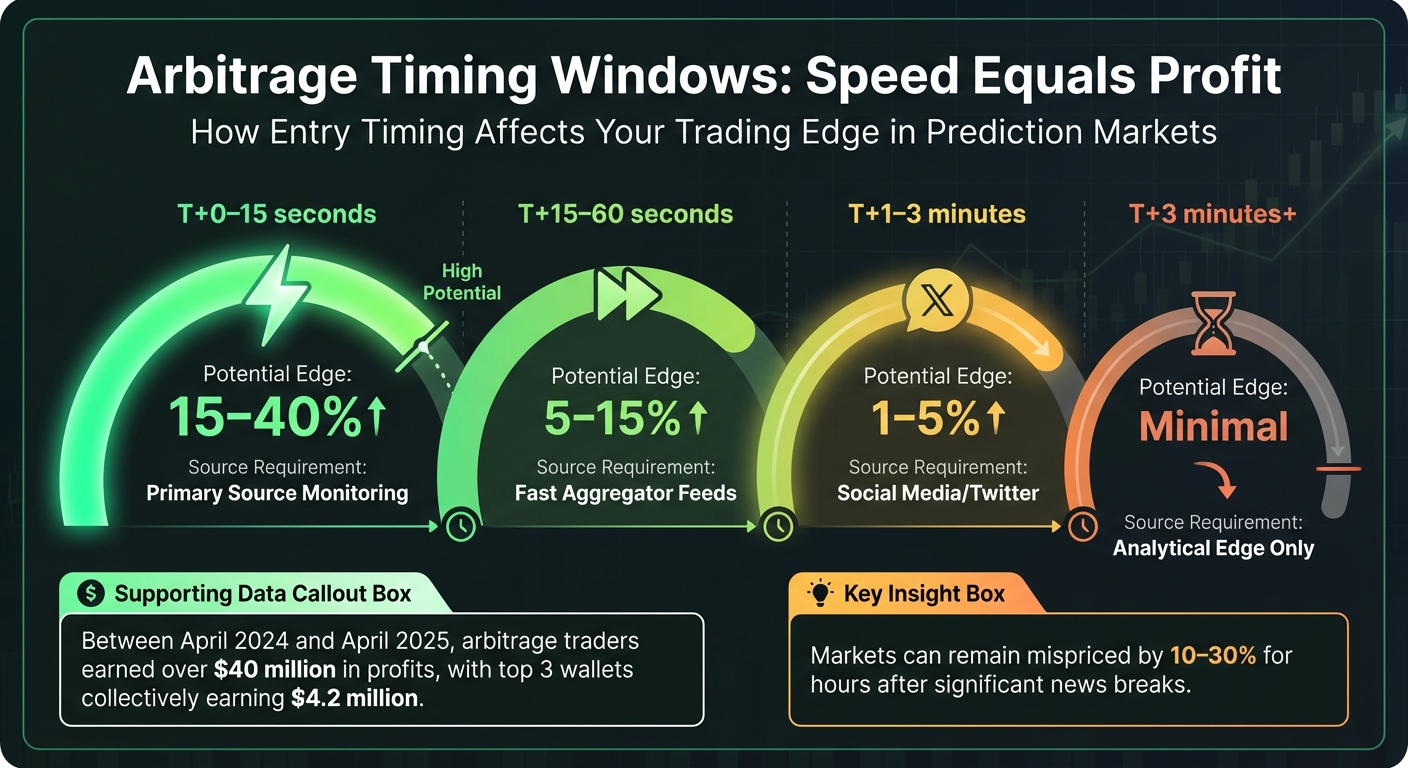
Discrepancies between news reports and prediction market prices often point to mispricings, creating opportunities for arbitrage. When news breaks and market prices don't adjust immediately - or move in the opposite direction - savvy traders can capitalize on the gap. These windows for action usually last from 30 seconds to a few minutes, offering potential gains of 15% to 40% for those who act quickly.
Here's a breakdown of how timing influences arbitrage opportunities:
| Entry Timing | Potential Edge | Source Requirement |
|---|---|---|
| T+0–15s | 15–40% | Primary Source Monitoring |
| T+15–60s | 5–15% | Fast Aggregator Feeds |
| T+1–3min | 1–5% | Social Media/Twitter |
| T+3min+ | Minimal | Analytical Edge Only |
Between April 2024 and April 2025, arbitrage traders pulled in over $40 million in profits from a major prediction market, with the top three wallets alone earning $4.2 million collectively. These opportunities often arise because markets can remain mispriced for hours after significant news breaks, sometimes by as much as 10–30%. The key is having the expertise to interpret the implications of breaking news and acting before the broader market adjusts.
How PolyTell Connects News and Prediction Market Data
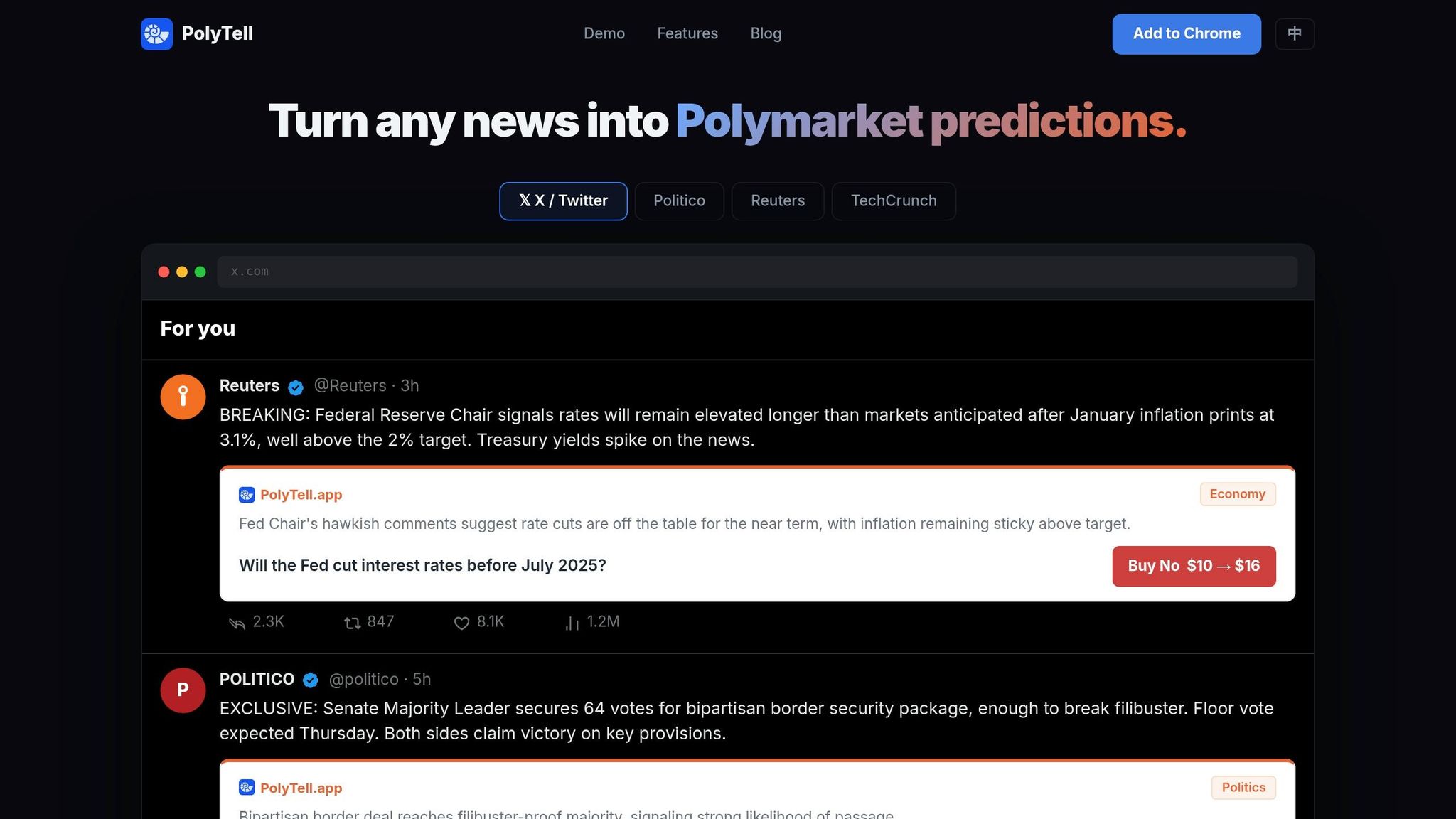
PolyTell brings live prediction market data straight into your browser, seamlessly blending news narratives with actionable market insights. This Chrome extension works across news and social platforms, analyzing content in real time to display relevant prediction market information exactly when and where you need it.
AI Event Extraction for Automatic Analysis
PolyTell's AI scans articles and social feeds to identify key events and link them to live Polymarket contracts. For example, in February 2025, the tool analyzed a TechCrunch article about OpenAI's $40 billion funding round and surfaced a related contract titled "Will OpenAI maintain a $300B+ valuation through 2025?" The AI also deciphers complex financial and political signals - such as Federal Reserve announcements - and connects them to relevant contracts like "Fed rate cut" markets.
"PolyTell's AI reads the content, extracts key events, and matches them against live Polymarket markets - no tab switching required."
- fengyiqicoder, Creator of PolyTell
During demonstrations, the AI successfully matched five events within a single article and generated ten betting recommendations from an X timeline. This automation eliminates guesswork, offering instant, on-page insights.
Inline Prediction Cards for Instant Data Access
PolyTell embeds prediction cards directly beneath relevant paragraphs or tweets, so you can stay focused on the content while accessing market data. These cards display the market question, current probabilities, and live prices, seamlessly connecting news with actionable insights. For instance, when BBC Breaking News tweeted about a snap UK general election in February 2025, PolyTell matched the story to a market titled "Will Labour win the next UK general election?" and displayed live odds ranging from $10 to $13 directly within the feed.
"Live prediction odds appear immediately beneath relevant content. No popups, no tab switching - just read and see the market's take."
- PolyTell.app
The extension supports both English and Chinese interfaces and works smoothly on major platforms like Bloomberg, Reuters, Axios, CNN, and BBC. By delivering critical data inline, PolyTell ensures you're ready to act immediately.
One-Click Betting to Act on Information Fast
PolyTell makes trading effortless with integrated "Buy Yes" and "Buy No" buttons, allowing you to place bets directly from the page. For example, during a spike in Treasury yields in February 2025, the tool analyzed a Reuters report on X about the Federal Reserve signaling elevated rates. It instantly linked the content to a Polymarket contract titled "Will the Fed cut interest rates before July 2025?" With one-click options to "Buy Yes" or "Buy No", users could act on live odds without delay.
This one-click functionality is especially crucial for seizing arbitrage opportunities, where every second counts.
Practical Methods for Using News and Prediction Data
Combining news with prediction data can unlock smarter trading decisions, but success requires a structured approach. A disciplined process is what separates profitable traders from the rest.
Set Your Baseline Before Breaking News Arrives
Prepare baseline models for recurring events before they happen. For example, when the Federal Reserve announces interest rate changes or the Bureau of Labor Statistics releases jobs reports, having pre-built benchmarks ensures you're ready to act without hesitation. These models allow for instantaneous Bayesian updating, replacing guesswork with precision.
"The top 1% of Polymarket traders don't have crystal balls. They have systems. They approach each market with a structured framework for estimating probabilities."
- VPN07
Start with the market price as your "prior" probability, then adjust it using Bayesian updating as new information comes in. If your updated estimate diverges from the market's odds, you may have spotted a profitable edge. This method takes the emotion out of trading, relying instead on disciplined, mathematical reasoning.
Once your baseline is ready, focus on monitoring rapid shifts in odds to seize short-lived opportunities.
Watch Odds Changes to Time Your Trades
Prediction markets often trail breaking news by 30 seconds to several minutes. The most lucrative window - T+0 to T+15 seconds - can offer a 15–40% edge if you're tracking primary sources like official government sites or press releases. By the time news filters through social media (typically three minutes later), markets are already 60–80% adjusted.
Professional traders follow a precise 30-second workflow during breaking events:
- 0–5 seconds: Review alerts from primary sources
- 5–10 seconds: Update implied probabilities
- 10–20 seconds: Navigate to pre-bookmarked market pages
- 20–30 seconds: Execute trades
To avoid delays, keep five to ten active market tabs pre-loaded in your browser.
Use Continuous Monitoring for Fast-Moving Markets
Constantly switching tabs manually can slow you down. Tools like PolyTell's AI streamline the process by scanning feeds like X/Twitter automatically, highlighting key events, and embedding prediction cards directly into your view. This tech-assisted approach complements manual speed strategies, especially in fast-paced markets.
For even quicker updates, set up Twitter alerts using the bell icon for critical accounts like @AP and @Reuters. These push notifications ensure you're among the first to know. One trader, known as "Axios", achieved a 96% win rate on mention markets simply by reacting faster than competitors. Still, take a few seconds - about five - to verify the source's accuracy before making a move.
Examples of News and Prediction Market Data Working Together
Real-world examples show how aligning news coverage with market probabilities can offer strategic insights.
Election Forecasts and Polling Data Reactions
Take the 2024 U.S. Presidential Election as an example. While cable news portrayed the race as evenly split, prediction markets told a different story. On election eve, these markets priced Donald Trump at 57%, even as polls remained locked at a 50/50 split.
An even more striking instance occurred in July 2024 when Joe Biden withdrew from the race. After the June debate, prediction markets had already adjusted, raising Biden's exit probability from 40% to 70%, even as news outlets continued to report his candidacy as "firm". However, markets aren't infallible. When Tim Walz was nominated as Biden's running mate in August 2024, traders had heavily favored Governor Josh Shapiro, giving him odds as high as 65%, while Walz's odds hovered between 8% and 25% until the news leaked. This misstep highlighted how markets can sometimes fall into echo chambers when critical information is tightly controlled.
Beyond elections, prediction markets also excel at offering quick insights into economic policy changes.
Economic Forecasts Using Central Bank Announcements
In late 2025, prediction markets accurately anticipated the Federal Reserve's decision to cut rates by 25 basis points. As inflation cooled to 2.4% and unemployment rose to 4.1%, traders pushed the probability of a rate cut from 45% in mid-November to 80% by November 24. Notably, some large-scale traders placed million-dollar bets while the odds were still below 60%, well ahead of the official announcement on December 11. By the time the dust settled, the market had reached a total volume of $393.9 million.
Another example came in January 2026, when traders used prediction markets to forecast Donald Trump's pick for Federal Reserve Chair. Kevin Warsh started with 55% probability, but after Trump publicly expressed support for Kevin Hassett to stay at the National Economic Council, Warsh's odds skyrocketed to 99.6%. Traders who bought Warsh shares at 55¢ enjoyed an 80% return when his nomination was confirmed on January 30, 2026. This market saw a total volume of $325 million.
These examples demonstrate how prediction markets can often outpace traditional news in anticipating key economic decisions.
Corporate Risk Assessment Through Market Probabilities
Prediction markets also shine in corporate forecasting. In December 2025, a trader reportedly made over $1.15 million by accurately predicting Google's "Year in Search" rankings and a product launch date, raising questions about the use of insider information. Similarly, in October 2025, a trader bet $40,000 on OpenAI launching an AI web browser by the end of the month, earning a 20% return. This prompted OpenAI to revise its policies and dismiss an employee for using confidential information to place bets.
In another instance, ahead of Apple's Q1 2026 earnings report, prediction markets showed 100% confidence that Apple stock would hold above $275. This stood in contrast to the options market, which implied a potential swing of ±4.8%. Such cases highlight how informed traders can use prediction markets to quantify risks more effectively than traditional financial tools, though they also underscore the risks of relying solely on market signals.
These scenarios illustrate how prediction markets not only complement traditional news but sometimes even outpace it in forecasting major events and trends.
Conclusion
Relying only on news to navigate the markets is like driving with one eye closed - you might see the road, but you're missing crucial signals. Savvy traders understand that blending news with other data sources paints a more complete and actionable picture.
Prediction markets often react before traditional media catches up, giving traders an early advantage. For instance, when AI sentiment analysis identifies a dovish Federal Reserve speech alongside a 73% probability of a rate cut, you're looking at a strong signal to base decisions on. Add to that the activity of wallets with win rates above 70% entering positions 48 hours ahead of significant market moves, and you're tracking informed capital rather than mere speculation.
"The market doesn't care about your opinion - it cares about the flow of informed capital." - 0xIcaruss
Traders who consistently see annual returns between 35% and 95% aren't relying on guesswork. They focus on primary sources during critical moments, plan their position sizes in advance, and use prediction markets as real-time checks against media narratives. This mix of contextual understanding and hard data forms the backbone of their strategies.
PolyTell simplifies this process by delivering these insights in one place, ensuring you catch events as they unfold without the hassle of switching between tabs.
Your advantage doesn't come from consuming more news - it comes from interpreting news alongside market signals. When the stories and probabilities align, that's where your trading edge lies.